Afirma GaliciaDiario...
La constructora San José ya ha llegado a un acuerdo para hacerse con un grupo de comunicación gallego. En estos momentos están buscando la persona que lidere ese proyecto.
Pero las operaciones de compra venta en el sector de medios de comunicación en Galicia no sólo se limitan a un grupo. Vocento y Prisa siguen empeñados en poner un pie en nuestra Comunidad Autónoma. Ejecutivos de ambos grupos viajan últimamente con frecuencia a Galicia, donde están iniciando nuevas negociaciones. Parece que 2006 nos dibuja un horizonte cambiante en el panorama mediático gallego.
23.12.05


22.12.05
Communication Research 1 February 2006; Vol. 33, No. 1
Perceived Similarity of Exemplar Traits and Behavior: Effects on Message Evaluation Julie L. Andsager, Victoria Bemker, Hong-Lim Choi, and Vitalis Torwel Communication Research 2006;33 3-18 http://crx.sagepub.com/cgi/content/abstract/33/1/3?etoc
Media Message Flows and Interpersonal Communication: The Conditional Natureof Effects on Public Opinion Claes H. de Vreese and Hajo G. Boomgaarden Communication Research 2006;33 19-37 http://crx.sagepub.com/cgi/content/abstract/33/1/19?etoc
Chinese Evaluations of Emotional Support Skills, Goals, and Behaviors: An Assessment of Gender-related Similarities and Differences Brant R. Burleson, Meina Liu, Yan Liu, and Steven T. Mortenson Communication Research 2006;33 38-63 http://crx.sagepub.com/cgi/content/abstract/33/1/38?etoc
Group Communication During Resource Dilemmas: 2. Effects of Harvest Limit and Reward Asymmetry Charles Pavitt, Vera Zingerman, Erin Towey, and Courtney McFeeters Communication Research 2006;33 64-91 http://crx.sagepub.com/cgi/content/abstract/33/1/64?etoc
An Analysis of Socioemotional and Task Communication in Online Multiplayer Video Games Jorge Pena and Jeffrey T. Hancock Communication Research 2006;33 92-109 http://crx.sagepub.com/cgi/content/abstract/33/1/92?etoc
Media Message Flows and Interpersonal Communication: The Conditional Natureof Effects on Public Opinion Claes H. de Vreese and Hajo G. Boomgaarden Communication Research 2006;33 19-37 http://crx.sagepub.com/cgi/content/abstract/33/1/19?etoc
Chinese Evaluations of Emotional Support Skills, Goals, and Behaviors: An Assessment of Gender-related Similarities and Differences Brant R. Burleson, Meina Liu, Yan Liu, and Steven T. Mortenson Communication Research 2006;33 38-63 http://crx.sagepub.com/cgi/content/abstract/33/1/38?etoc
Group Communication During Resource Dilemmas: 2. Effects of Harvest Limit and Reward Asymmetry Charles Pavitt, Vera Zingerman, Erin Towey, and Courtney McFeeters Communication Research 2006;33 64-91 http://crx.sagepub.com/cgi/content/abstract/33/1/64?etoc
An Analysis of Socioemotional and Task Communication in Online Multiplayer Video Games Jorge Pena and Jeffrey T. Hancock Communication Research 2006;33 92-109 http://crx.sagepub.com/cgi/content/abstract/33/1/92?etoc
20.12.05
FEIRA AUDIOVISUAL VIAXES NA LUSOFONÍA

 Tal como xa lle informamos con anterioridade, estamos organizando unha Feira de Produtos Audiovisuais chamada "Viaxes na Lusofonia" que se desenvolverá en paralelo á celebración do VII Congreso Internacional de Comunicación Lusófona, LUSOCOM 2006, que terá lugar en Santiago de Compostela (Galiza) os días 21 e 22 de abril de 2006 ( http://www.novosmedios.org/lusocom).
Estamos recabando materiais de creadores individuais e pequenas produtoras. Pensamos que pode ser unha boa oportunidade para difundir as súas obras en Galiza e coñecer outras producións independentes. A mostra está aberta a longametraxes e curtametraxes, de fición e documentarios, de Portugal, Galiza, Brasil e a África Lusófona. O evento servirá asemade como ponto de encontro entre creadores, e lugar de intercambio comercial entre os creadores e produtoras e distribuidoras. Debido á cantidade de respostas positivas que estamos recibindo tanto en Portugal, en Brasil, en Galiza e nos países da África lusófona, pensamos que o encontro será moi positivo como posta en común de experiencias e que a calidade das producións presentadas será igualmente moi alta.
Ademais, durante os dous días nos que terá lugar a Feira Audiovisual instalaranse na Facultade de Ciencias da Comunicación un conxunto de stands que poderán ser empregados por vostedes para a distribución de material informativo e promocional. Polo tanto, tanto se envían producións ou non, poden remitirnos todos os materiais promocionais que desexen, para que poida ser distribuído nestes stands.
De estar interesados en participar, gustarianos que o confirmase antes do día 23 de xaneiro e, se fose posíbel, que antes desa data nos remitise os títulos das producións coas que participaría nesta mostra audiovisual. Ademais, necesitariamos outros datos sobre o filme: realización, guion, produción, distribución e sinopse. A data límite (deadline) para a recepción das producións será o 1 de marzo e o formato no que deben enviar os materiais é DVD universal.
A Feira Audiovisual "Viaxes na Lusofonía" está coordinada polo profesor Marcelo Martínez, da Facultade de Ciencias da Comunicación da Universidade de Santiago de Compostela.
Feira Audiovisual "Viaxes na Lusofonia": viaxesnalusofonia#gmail.com
16.12.05
Special Issue of Public Opinion Quarterly: Polling Politics, Media, and Election Campaigns
Did the polls “get it wrong” in the 2004 election? Do certain polls have a “liberal” or “conservative” bias, as alleged by partisans in the campaign? Did journalists accurately cover polling controversies in 2004, or did they contribute to them? These and other questions are addressed in an upcoming special issue of Public Opinion Quarterly, which will be published in December, 2005.This special issue of POQ, edited by Lawrence Jacobs and Robert Shapiro, examines the polls, the media and their evolving relationship. Appearing on the 25th anniversary of an influential POQ symposium on the polls and the media, this issue assembles an extraordinary collection of national experts to take current stock of “the polls,” media reporting on them, and their use in the American political process at the beginning of the 21st century.
Polling Politics, Media, and Election Campaigns Lawrence R. Jacobs and Robert Y. Shapiro Public Opin Q 2005 69: 635-641. http://poq.oxfordjournals.org/cgi/content/full/69/5/635?etoc-
The Methods and Accuracy of Polling
The Accuracy of the National Preelection Polls in the 2004 Presidential Election Michael W. Traugott Public Opin Q 2005 69: 642-654. http://poq.oxfordjournals.org/cgi/content/abstract/69/5/642?etoc
Toward an Open-Source Methodology: What We Can Learn from the Blogosphere Mark M. Blumenthal Public Opin Q 2005 69: 655-669. http://poq.oxfordjournals.org/cgi/content/abstract/69/5/655?etoc
Pollsters Under Attack: 2004 Election Incivility and Its Consequences Robert P. Daves and Frank Newport Public Opin Q 2005 69: 670-681. http://poq.oxfordjournals.org/cgi/content/abstract/69/5/670?etoc
Polling and the Media
Reporting "The Polls" in 2004 Kathleen A. Frankovic Public Opin Q 2005 69: 682-697. http://poq.oxfordjournals.org/cgi/content/abstract/69/5/682?etoc
Political Polling and the New Media Culture: A Case of More Being Less Tom Rosenstiel Public Opin Q 2005 69: 698-715. http://poq.oxfordjournals.org/cgi/content/abstract/69/5/698?etoc
Of Polls, Mountains: U.S. Journalists and Their Use of Election Surveys Thomas E. Patterson Public Opin Q 2005 69: 716-724. http://poq.oxfordjournals.org/cgi/content/abstract/69/5/716?etoc
Can a Poll Affect Perception of Candidate Traits? Bruce W. Hardy and Kathleen Hall Jamieson Public Opin Q 2005 69: 725-743. http://poq.oxfordjournals.org/cgi/content/abstract/69/5/725?etoc
Voters and Values in the 2004 Election Gary Langer and Jon Cohen Public Opin Q 2005 69: 744-759. http://poq.oxfordjournals.org/cgi/content/abstract/69/5/744?etoc
Polls, Voters, and American Politics
Grassroots Mobilization and Voter Turnout in 2004 Daniel E. Bergan, Alan S. Gerber, Donald P. Green, and Costas Panagopoulos Public Opin Q 2005 69: 760-777. http://poq.oxfordjournals.org/cgi/content/abstract/69/5/760?etoc
Inequality and Democratic Responsiveness Martin Gilens Public Opin Q 2005 69: 778-796. http://poq.oxfordjournals.org/cgi/content/abstract/69/5/778?etoc
Polling Politics, Media, and Election Campaigns Lawrence R. Jacobs and Robert Y. Shapiro Public Opin Q 2005 69: 635-641. http://poq.oxfordjournals.org/cgi/content/full/69/5/635?etoc-
The Methods and Accuracy of Polling
The Accuracy of the National Preelection Polls in the 2004 Presidential Election Michael W. Traugott Public Opin Q 2005 69: 642-654. http://poq.oxfordjournals.org/cgi/content/abstract/69/5/642?etoc
Toward an Open-Source Methodology: What We Can Learn from the Blogosphere Mark M. Blumenthal Public Opin Q 2005 69: 655-669. http://poq.oxfordjournals.org/cgi/content/abstract/69/5/655?etoc
Pollsters Under Attack: 2004 Election Incivility and Its Consequences Robert P. Daves and Frank Newport Public Opin Q 2005 69: 670-681. http://poq.oxfordjournals.org/cgi/content/abstract/69/5/670?etoc
Polling and the Media
Reporting "The Polls" in 2004 Kathleen A. Frankovic Public Opin Q 2005 69: 682-697. http://poq.oxfordjournals.org/cgi/content/abstract/69/5/682?etoc
Political Polling and the New Media Culture: A Case of More Being Less Tom Rosenstiel Public Opin Q 2005 69: 698-715. http://poq.oxfordjournals.org/cgi/content/abstract/69/5/698?etoc
Of Polls, Mountains: U.S. Journalists and Their Use of Election Surveys Thomas E. Patterson Public Opin Q 2005 69: 716-724. http://poq.oxfordjournals.org/cgi/content/abstract/69/5/716?etoc
Can a Poll Affect Perception of Candidate Traits? Bruce W. Hardy and Kathleen Hall Jamieson Public Opin Q 2005 69: 725-743. http://poq.oxfordjournals.org/cgi/content/abstract/69/5/725?etoc
Voters and Values in the 2004 Election Gary Langer and Jon Cohen Public Opin Q 2005 69: 744-759. http://poq.oxfordjournals.org/cgi/content/abstract/69/5/744?etoc
Polls, Voters, and American Politics
Grassroots Mobilization and Voter Turnout in 2004 Daniel E. Bergan, Alan S. Gerber, Donald P. Green, and Costas Panagopoulos Public Opin Q 2005 69: 760-777. http://poq.oxfordjournals.org/cgi/content/abstract/69/5/760?etoc
Inequality and Democratic Responsiveness Martin Gilens Public Opin Q 2005 69: 778-796. http://poq.oxfordjournals.org/cgi/content/abstract/69/5/778?etoc
14.12.05
La Voz de Galicia, en picado: a fin do efecto Prestige


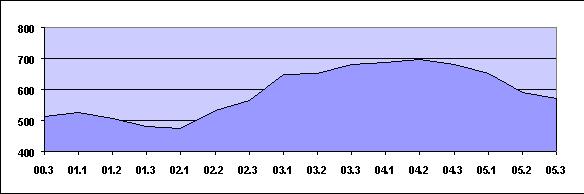
La Voz de Galicia segue baixando. Os últimos datos do EGM, publicados onte amosan un novo descenso de 18.000 lectores, que sumados aos anteriores significan unha caída total de 124.000 lectores dende mediados de 2004, cando acadou o seu record histórico (696 mil). 124 mil lectores menos en ano e medio. Este descenso é tamén evidente nas cifras da OJD, que indican un descenso de 8.000 exemplares nos últimos 3 anos, situando ao xornal nos seus peores números dende 1990.
¿É esta a fin do efecto Prestige? A estratexia levada a cabo polo xornal entre novembro e decembro de 2002, consistente nunha denuncia feroz da labor do Partido Popular ante a catástrofe, conseguiu o seu obxectivo: gañar a simpatía de moitos galegos, sobre todo dos máis novos, que se converteron en lectores de La Voz. A consecuencia disto, o xornal gañou máis de 200.000 lectores en dous anos. Porén, nos últimos 18 meses esa tendencia inverteuse.
¿Cal pode ser a razón? ¿O xiro dereitista e ferozmente enfrontado co galeguismo? ¿Ou a propia cobertura sobre o Prestige? A partir de xaneiro de 2003 La Voz pregouse ás versións oficiais difundidas dende a Xunta e dende a Moncloa e converteuse nun dos medios máis acríticos coa xestión do PP e, á vez, máis críticos con colectivos como Nunca Máis. La Voz desencantou daquela a centos de milleiros de galegos e agora está pagando as consecuencias. ¿Canto tempo resistirá?
The Harvard International Journal of Press/Politics 1 January 2006; Vol. 11, No. 1
Still the Wasteland?: An Interview with Newton Minow Alex Jones The Harvard International Journal of Press/Politics 2006;11 3-8 http://hij.sagepub.com/cgi/reprint/11/1/3?etoc
Reform, Rescue, or Run Out of Money?: Problem Definition in the Social Security Reform Debate Jennifer Jerit The Harvard International Journal of Press/Politics 2006;11 9-28 http://hij.sagepub.com/cgi/content/abstract/11/1/9?etoc
News Consumption and the New Electronic Media Douglas Ahlers The Harvard International Journal of Press/Politics 2006;11 29-52 http://hij.sagepub.com/cgi/content/abstract/11/1/29?etoc
The 2004 New Hampshire Democratic Primary and Network News Stephen J. Farnsworth and S. Robert Lichter The Harvard International Journal of Press/Politics 2006;11 53-63 http://hij.sagepub.com/cgi/content/abstract/11/1/53?etoc
Still the Middle Way: A Study of Political Communication Practices in Swedish Election Campaigns Lars W. Nord The Harvard International Journal of Press/Politics 2006;11 64-76 http://hij.sagepub.com/cgi/content/abstract/11/1/64?etoc
Watchdog or Good Neighbor?: The Public's Expectations of Local News Paula M. Poindexter, Don Heider, and Maxwell McCombs The Harvard International Journal of Press/Politics 2006;11 77-88 http://hij.sagepub.com/cgi/content/abstract/11/1/77?etoc
Book Notes Scott L. Althaus The Harvard International Journal of Press/Politics 2006;11 89-90 http://hij.sagepub.com/cgi/reprint/11/1/89?etoc
Reform, Rescue, or Run Out of Money?: Problem Definition in the Social Security Reform Debate Jennifer Jerit The Harvard International Journal of Press/Politics 2006;11 9-28 http://hij.sagepub.com/cgi/content/abstract/11/1/9?etoc
News Consumption and the New Electronic Media Douglas Ahlers The Harvard International Journal of Press/Politics 2006;11 29-52 http://hij.sagepub.com/cgi/content/abstract/11/1/29?etoc
The 2004 New Hampshire Democratic Primary and Network News Stephen J. Farnsworth and S. Robert Lichter The Harvard International Journal of Press/Politics 2006;11 53-63 http://hij.sagepub.com/cgi/content/abstract/11/1/53?etoc
Still the Middle Way: A Study of Political Communication Practices in Swedish Election Campaigns Lars W. Nord The Harvard International Journal of Press/Politics 2006;11 64-76 http://hij.sagepub.com/cgi/content/abstract/11/1/64?etoc
Watchdog or Good Neighbor?: The Public's Expectations of Local News Paula M. Poindexter, Don Heider, and Maxwell McCombs The Harvard International Journal of Press/Politics 2006;11 77-88 http://hij.sagepub.com/cgi/content/abstract/11/1/77?etoc
Book Notes Scott L. Althaus The Harvard International Journal of Press/Politics 2006;11 89-90 http://hij.sagepub.com/cgi/reprint/11/1/89?etoc
7.12.05
Journal of Communication (December 2005; Vol. 55, No. 4)
2004 ICA Presidential Address-----------------------------------------------------------------
How We Talk About How We Talk: Communication Theory in the Public Interest Robert T. Craig J Commun 2005 55: 659-667. http://joc.oxfordjournals.org/cgi/content/abstract/55/4/659?etoc
Research Articles-----------------------------------------------------------------
A (Re)Conceived Feminist Paradigm for Public Relations: A Case for Substantial Improvement Linda Aldoory J Commun 2005 55: 668-684. http://joc.oxfordjournals.org/cgi/content/abstract/55/4/668?etoc
The Role of Trust in Channels of Strategic Communication for Building Civil Society Carl H. Botan and Maureen Taylor J Commun 2005 55: 685-702. http://joc.oxfordjournals.org/cgi/content/abstract/55/4/685?etoc
Publish or Perish: A Limited Author Analysis of ICA and NCA Journals Ulla Bunz J Commun 2005 55: 703-720. http://joc.oxfordjournals.org/cgi/content/abstract/55/4/703?etoc
A Social Skill Account of Problematic Internet Use Scott E. Caplan J Commun 2005 55: 721-736. http://joc.oxfordjournals.org/cgi/content/abstract/55/4/721?etoc
Use and Disuse of Contextual Primes in Dynamic News Environments Young Mie Kim J Commun 2005 55: 737-755. http://joc.oxfordjournals.org/cgi/content/abstract/55/4/737?etoc
The Genesis of Civic Awareness: Agenda Setting in Political Socialization Spiro Kiousis, Michael McDevitt, and Xu Wu J Commun 2005 55: 756-774. http://joc.oxfordjournals.org/cgi/content/abstract/55/4/756?etoc
Unifying or Polarizing? Short-Term Effects and Postdebate Consequences of Different Rhetorical Strategies in Televised Debates Carsten Reinemann and Marcus Maurer J Commun 2005 55: 775-794. http://joc.oxfordjournals.org/cgi/content/abstract/55/4/775?etoc
Economic Individualism, Humanitarianism, and Welfare Reform: A Value-Based Account of Framing Effects Fuyuan Shen and Heidi Hatfield Edwards J Commun 2005 55: 795-809. http://joc.oxfordjournals.org/cgi/content/abstract/55/4/795?etoc
Media Exposure and Attention as Mediating Variables Influencing Social Risk Judgments Michael D. Slater and Kenneth A. Rasinski J Commun 2005 55: 810-827. http://joc.oxfordjournals.org/cgi/content/abstract/55/4/810?etoc
The Rules of Virtual Groups: Trust, Liking, and Performance in Computer-Mediated Communication Joseph B. Walther and Ulla Bunz J Commun 2005 55: 828-846. http://joc.oxfordjournals.org/cgi/content/abstract/55/4/828?etoc
Parental Mediation of Children's Television Viewing in Low-Income Families Ron Warren J Commun 2005 55: 847-863. http://joc.oxfordjournals.org/cgi/content/abstract/55/4/847?etoc
Review and Criticism-----------------------------------------------------------------
The State of Media Literacy Education: Media Education: Literacy, Learning and Contemporary Culture. By David Buckingham. Cambridge, UK: Polity/Blackwell, 2003. 232 pp. $64.95 (hard), $28.95 (soft). * Teaching Youth Media: A Critical Guide to Literacy, Video Production and Social Change. By Steven Goodman. New York: Teachers College Press, 2003. 144 pp. $42.00 (hard), $19.95 (soft). * Theory of Media Literacy: A Cognitive Approach. By W. James Potter. Thousand Oaks, CA: Sage, 2004. $85.95 (hard), $43.95 (soft). Renee Hobbs J Commun 2005 55: 865-871. http://joc.oxfordjournals.org/cgi/reprint/55/4/865?etoc
Fairness and Effectiveness in Policing: The Evidence: Edited by Wesley Skogan & Kathleen Frydl. National Research Council Committee to Review Research on Police Policy & Practices, Committee on Law & Justice, Division of Behavioral & Social Sciences & Education. Washington, DC: National Academies Press, 2004. pp. xiii + 413. $44.95 (hard). Michelle Chernikoff Anderson and Howard Giles J Commun 2005 55: 872-874. http://joc.oxfordjournals.org/cgi/reprint/55/4/872?etoc
Oprah Winfrey and the Glamour of Misery: An Essay on Popular Culture: By Eva Illouz. New York: Columbia University Press, 2003. 300 pp. $73.50 (hard), $24.00 (soft). David W. Park J Commun 2005 55: 874-875. http://joc.oxfordjournals.org/cgi/reprint/55/4/874?etoc
Classical Film Violence: Designing and Regulating Brutality in Hollywood Cinema, 1930-1968: By Stephen Prince. New Brunswick, NJ: Rutgers University Press, 2003. 331 pp. $62.00 (hard), $23.00 (soft). Paul Messaris J Commun 2005 55: 875-876. http://joc.oxfordjournals.org/cgi/reprint/55/4/875?etoc
Big Media, Big Money: Cultural Texts and Political Economics: By Ronald V. Bettig & Jeanne Lynn Hall. Lanham, MD: Rowman & Littlefield, 2003. x + 181 pp. $65.00 (hard), $24.95 (soft). Eileen R. Meehan J Commun 2005 55: 876-878. http://joc.oxfordjournals.org/cgi/reprint/55/4/876?etoc
The Press Effect: Politicians, Journalists, and the Stories That Shape the Political World: By Kathleen Hall Jamieson & Paul Waldman. New York: Oxford University Press, 2002. 240 pp. $26.00 (hard), $14.95 (soft) Weiwu Zhang J Commun 2005 55: 878-880. http://joc.oxfordjournals.org/cgi/reprint/55/4/878?etoc
The Psychology of Entertainment Media: Blurring the Lines Between Entertainment and Persuasion: Edited by L. J. Shrum. Mahwah, NJ: Erlbaum, 2004. 376 pp. $89.95 (hard), $39.95 (discounted). Jan Van den Bulck J Commun 2005 55: 880-882. http://joc.oxfordjournals.org/cgi/reprint/55/4/880?etoc
Survivor Lessons: Essays on Communication and Reality Television: Edited by Matthew J. Smith & Andrew F. Wood. Jefferson, NC: McFarland, 2003. 241 pp. $39.95 (paper). Hillary Warren J Commun 2005 55: 882-883. http://joc.oxfordjournals.org/cgi/reprint/55/4/882?etoc
How We Talk About How We Talk: Communication Theory in the Public Interest Robert T. Craig J Commun 2005 55: 659-667. http://joc.oxfordjournals.org/cgi/content/abstract/55/4/659?etoc
Research Articles-----------------------------------------------------------------
A (Re)Conceived Feminist Paradigm for Public Relations: A Case for Substantial Improvement Linda Aldoory J Commun 2005 55: 668-684. http://joc.oxfordjournals.org/cgi/content/abstract/55/4/668?etoc
The Role of Trust in Channels of Strategic Communication for Building Civil Society Carl H. Botan and Maureen Taylor J Commun 2005 55: 685-702. http://joc.oxfordjournals.org/cgi/content/abstract/55/4/685?etoc
Publish or Perish: A Limited Author Analysis of ICA and NCA Journals Ulla Bunz J Commun 2005 55: 703-720. http://joc.oxfordjournals.org/cgi/content/abstract/55/4/703?etoc
A Social Skill Account of Problematic Internet Use Scott E. Caplan J Commun 2005 55: 721-736. http://joc.oxfordjournals.org/cgi/content/abstract/55/4/721?etoc
Use and Disuse of Contextual Primes in Dynamic News Environments Young Mie Kim J Commun 2005 55: 737-755. http://joc.oxfordjournals.org/cgi/content/abstract/55/4/737?etoc
The Genesis of Civic Awareness: Agenda Setting in Political Socialization Spiro Kiousis, Michael McDevitt, and Xu Wu J Commun 2005 55: 756-774. http://joc.oxfordjournals.org/cgi/content/abstract/55/4/756?etoc
Unifying or Polarizing? Short-Term Effects and Postdebate Consequences of Different Rhetorical Strategies in Televised Debates Carsten Reinemann and Marcus Maurer J Commun 2005 55: 775-794. http://joc.oxfordjournals.org/cgi/content/abstract/55/4/775?etoc
Economic Individualism, Humanitarianism, and Welfare Reform: A Value-Based Account of Framing Effects Fuyuan Shen and Heidi Hatfield Edwards J Commun 2005 55: 795-809. http://joc.oxfordjournals.org/cgi/content/abstract/55/4/795?etoc
Media Exposure and Attention as Mediating Variables Influencing Social Risk Judgments Michael D. Slater and Kenneth A. Rasinski J Commun 2005 55: 810-827. http://joc.oxfordjournals.org/cgi/content/abstract/55/4/810?etoc
The Rules of Virtual Groups: Trust, Liking, and Performance in Computer-Mediated Communication Joseph B. Walther and Ulla Bunz J Commun 2005 55: 828-846. http://joc.oxfordjournals.org/cgi/content/abstract/55/4/828?etoc
Parental Mediation of Children's Television Viewing in Low-Income Families Ron Warren J Commun 2005 55: 847-863. http://joc.oxfordjournals.org/cgi/content/abstract/55/4/847?etoc
Review and Criticism-----------------------------------------------------------------
The State of Media Literacy Education: Media Education: Literacy, Learning and Contemporary Culture. By David Buckingham. Cambridge, UK: Polity/Blackwell, 2003. 232 pp. $64.95 (hard), $28.95 (soft). * Teaching Youth Media: A Critical Guide to Literacy, Video Production and Social Change. By Steven Goodman. New York: Teachers College Press, 2003. 144 pp. $42.00 (hard), $19.95 (soft). * Theory of Media Literacy: A Cognitive Approach. By W. James Potter. Thousand Oaks, CA: Sage, 2004. $85.95 (hard), $43.95 (soft). Renee Hobbs J Commun 2005 55: 865-871. http://joc.oxfordjournals.org/cgi/reprint/55/4/865?etoc
Fairness and Effectiveness in Policing: The Evidence: Edited by Wesley Skogan & Kathleen Frydl. National Research Council Committee to Review Research on Police Policy & Practices, Committee on Law & Justice, Division of Behavioral & Social Sciences & Education. Washington, DC: National Academies Press, 2004. pp. xiii + 413. $44.95 (hard). Michelle Chernikoff Anderson and Howard Giles J Commun 2005 55: 872-874. http://joc.oxfordjournals.org/cgi/reprint/55/4/872?etoc
Oprah Winfrey and the Glamour of Misery: An Essay on Popular Culture: By Eva Illouz. New York: Columbia University Press, 2003. 300 pp. $73.50 (hard), $24.00 (soft). David W. Park J Commun 2005 55: 874-875. http://joc.oxfordjournals.org/cgi/reprint/55/4/874?etoc
Classical Film Violence: Designing and Regulating Brutality in Hollywood Cinema, 1930-1968: By Stephen Prince. New Brunswick, NJ: Rutgers University Press, 2003. 331 pp. $62.00 (hard), $23.00 (soft). Paul Messaris J Commun 2005 55: 875-876. http://joc.oxfordjournals.org/cgi/reprint/55/4/875?etoc
Big Media, Big Money: Cultural Texts and Political Economics: By Ronald V. Bettig & Jeanne Lynn Hall. Lanham, MD: Rowman & Littlefield, 2003. x + 181 pp. $65.00 (hard), $24.95 (soft). Eileen R. Meehan J Commun 2005 55: 876-878. http://joc.oxfordjournals.org/cgi/reprint/55/4/876?etoc
The Press Effect: Politicians, Journalists, and the Stories That Shape the Political World: By Kathleen Hall Jamieson & Paul Waldman. New York: Oxford University Press, 2002. 240 pp. $26.00 (hard), $14.95 (soft) Weiwu Zhang J Commun 2005 55: 878-880. http://joc.oxfordjournals.org/cgi/reprint/55/4/878?etoc
The Psychology of Entertainment Media: Blurring the Lines Between Entertainment and Persuasion: Edited by L. J. Shrum. Mahwah, NJ: Erlbaum, 2004. 376 pp. $89.95 (hard), $39.95 (discounted). Jan Van den Bulck J Commun 2005 55: 880-882. http://joc.oxfordjournals.org/cgi/reprint/55/4/880?etoc
Survivor Lessons: Essays on Communication and Reality Television: Edited by Matthew J. Smith & Andrew F. Wood. Jefferson, NC: McFarland, 2003. 241 pp. $39.95 (paper). Hillary Warren J Commun 2005 55: 882-883. http://joc.oxfordjournals.org/cgi/reprint/55/4/882?etoc
Electing to Fight. Why Emerging Democracies Go to War (Edward D. Mansfield and Jack Snyder)

Does the spread of democracy really contribute to international peace? Successive U. S. administrations have justified various policies intended to promote democracy not only by arguing that democracy is intrinsically good but by pointing to a wide range of research concluding that democracies rarely, if ever, go to war with one another. To promote democracy, the United States has provided economic assistance, political support, and technical advice to emerging democracies in Eastern and Central Europe, and it has attempted to remove undemocratic regimes through political pressure, economic sanctions, and military force. In Electing to Fight, Edward Mansfield and Jack Snyder challenge the widely accepted basis of these policies by arguing that states in the early phases of transitions to democracy are more likely than other states to become involved in war.
Drawing on both qualitative and quantitative analysis, Mansfield and Snyder show that emerging democracies with weak political institutions are especially likely to go to war. Leaders of these countries attempt to rally support by invoking external threats and resorting to belligerent, nationalist rhetoric. Mansfield and Snyder point to this pattern in cases ranging from revolutionary France to contemporary Russia. Because the risk of a state's being involved in violent conflict is high until democracy is fully consolidated, Mansfield and Snyder argue, the best way to promote democracy is to begin by building the institutions that democracy requires -- such as the rule of law -- and only then encouraging mass political participation and elections. Readers will find this argument particularly relevant to prevailing concerns about the transitional government in Iraq. Electing to Fight also calls into question the wisdom of urging early elections elsewhere in the Islamic world and in China.
Edward D. Mansfield is Hum Rosen Professor of Political Science at the University of Pennsylvania. He is the author of Power, Trade, and War and International Conflict and the Global Economy.
Jack Snyder is the Robert and Renée Belfer Professor of International Relations at Columbia University. He is the author of From Voting to Violence: Democratization and Nationalist Conflict; Myths of Empire: Domestic Politics and International Ambition; and The Ideology of the Offensive: Military Decision Making and the Disasters of 1914.
Endorsements
"American foreign policy has been based on the premise that democracy promotes peace. Electing to Fight conclusively shows, however, that democratization, when mishandled, leads to war. Its challenge to the conventional beliefs of scholars and politicians makes it one of the most important books on international affairs in recent decades."
--Samuel P. Huntington, Albert J. Weatherhead III University Professor, Harvard University
"Everyone agrees that democracies make peace not war. But is that true? Jack Snyder and Edward Mansfield have posed the question and answered it with great rigor and sophistication. The result is an important book that describes a far more complicated relationship between democratization and peace than simple-minded rhetoric would suggest."
--Fareed Zakaria, Editor, Newsweek International
"With notable analytic agility and rigorous empiricism Mansfield and Snyder dissect the popular policy nostrum that promoting democracy abroad promotes peace in the world. Their incisive work will help policymakers steer clear of misleading, facile assumptions and impel scholars to dig deeper and think harder on a subject of critical contemporary importance."
--Thomas Carothers, Director, Democracy and Rule of Law Project, Carnegie Endowment for International Peace
The Perilous Path to the Democratic Peace Sample Chapter - Download PDF (123 KB)
Index of Subjects Sample Chapter - Download PDF (106 KB)
Protecting Liberty in an Age of Terror (Philip B. Heymann and Juliette N. Kayyem)

Since September 11, 2001, much has been said about the difficult balancing act between freedom and security, but few have made specific proposals for how to strike that balance. As the scandals over the abuse of Iraqi prisoners at Abu Ghraib and the "torture memos" written by legal officials in the Bush administration show, without clear rules in place, things can very easily go very wrong.
With this challenge in mind, Philip Heymann and Juliette Kayyem, directors of Harvard's Long-Term Legal Strategy Project for Preserving Security and Democratic Freedoms in the War on Terrorism, take a detailed look at how to handle these competing concerns. Taking into account both the national security viewpoint and the democratic freedoms viewpoint, Heymann and Kayyem consulted experts from across the political spectrum -- including Rand Beers, Robert McNamara, and Michael Chertoff (since named Secretary of Homeland Security) -- about the thorniest and most profound legal challenges of this new era. Heymann and Kayyem offer specific recommendations for dealing with such questions as whether assassination is ever acceptable, when coercion can be used in interrogation, and when detention is allowable. They emphasize that drawing clear rules to guide government conduct protects the innocent from unreasonable government intrusion and prevents government agents from being made scapegoats later if things go wrong. Their recommendations will be of great interest to legal scholars, legislators, policy professionals, and concerned citizens.
Philip Heymann is James Barr Ames Professor of Law at the Harvard Law School. From his first job as clerk to US Supreme Court Justice John Harlan to his post as Deputy US Attorney General (1993-1994), Heymann has spent much of his career in government. A former Fulbright Scholar with degrees from Yale University, Harvard Law School, and the Sorbonne, he has been Assistant US Attorney General in charge of the criminal division (1978-1981) and Assistant to the Solicitor General in the Justice Department, Acting Administrator of the State Department's Bureau of Security and Consular Affairs, Deputy Assistant Secretary of State for the Bureau of International Organizations, and Executive Assistant to the Undersecretary of State. In addition, he was a former Associate Prosecutor and Consultant to the Watergate Special Force. He is the author of Terrorism, Freedom, and Security: Winning without War (MIT Press, 2003).
Juliette Kayyem is Lecturer in Public Policy at Harvard University's Kennedy School of Government; former Member of the National Commission on Terrorism; and former Legal Adviser to the Attorney General.
Endorsements
"The terrorist attacks of 9/11 have been analyzed at great length, as have the deficiencies in America's defenses that led to these horrific acts. Now, for the first time, two of America's top experts on constitutional law and national security--Philip Heymann and Juliette Kayyem--have provided a comprehensive framework with which America's policymakers can meet the challenges posed by the terrorist mind in a way that respects rather than undermines the true foundations of liberty. Current and future policymakers ignore this blueprint at our peril."
--Bob Barr, member of the U.S. House of Representatives 1995-2003, 21st Century Liberties Chair for Freedom and Privacy at the American Conservative Union
"Since September 11, many have talked about the difficult tradeoffs between liberty and security, but few have seriously considered how to manage them. In this book, Heymann and Kayyem confront these tradeoffs head-on in the context of addressing the ten most difficult legal challenges presented by the war on terrorism. One need not agree with every detail of their analysis or proposals to appreciate that this book is the most thoughtful, balanced, and comprehensive analysis of these hard legal issues available anywhere."
--Jack Landman Goldsmith, Henry L. Shattuck Professor of Law, Harvard Law School
"In fighting the war on terror, we cannot abandon the legal and moral principles that have made us a great nation. Harvard's Phil Heymann and Juliette Kayyem, who have direct experience in fighting terrorism, have produced this extraordinarily thoughtful work containing many specific measures that would not only enhance our ability to fight terrorism but also preserve our essential liberties. It should be read by the President and Congress, who should then move quickly to adopt as many of its suggestions as possible."
--Jeffrey H. Smith, former General Counsel of the CIA and Senior Partner with the Washington, D.C., law firm of Arnold & Porter
Introduction Sample Chapter - Download PDF (130 KB)
Index Sample Chapter - Download PDF (115 KB)
2.12.05
Vítimas da desinformación
A crecente "inseguridade informacional", a disconformidade social coa actuación dos medios de comunicación centrou onte o discurso co que Ignacio Ramonet clausurou as xornadas sobre ‘Documentación e Poder’ do Consello da Cultura Galega.
O director de Le Monde Diplomatique compartiu cun ateigado auditorio a súa experiencia como membro fundador do Observatorio Internacional de Medios de Comunicación como proba palpable de que "a cidadanía madurou e é máis consciente de que algo non funciona".
Ao seu ver, e a pesar de que "houbo épocas peores" e "de que nas ditaduras a situación é extrema", nas democracias, a tendencia dos medios "a supeditarse ao poder económico" deixa insatisfeita "a unha porcentaxe cada vez maior de persoas, que sumaron a desconfianza informativa a outras inseguridades, como a laboral ou a sanitaria".
Froito desta situación xurdiu no Foro Social de Porto Alegre no ano 2002 a idea de constituír o Observatorio Internacional de Medios de Comunicación, posto en marcha de xeito oficial un ano despois, como un "contrapoder necesario" exercido pola sociedade civil. A modo de rede e integrado fundamentalmente por universitarios, xornalistas e persoas a título individual, para Ramonet o Observatorio demostrou no seu tempo de vida que "a sociedade pode influenciar ou corrixir o curso da información".
"Existe –di– unha vontade moi combativa e en moitos lugares os observatorios, como os latinoamericanos ou o FAIR en EEUU, plasman en boicot aos medios que traizoan a información". A "importante irritación" que os medios suscitan na poboación xustifica, ao seu ver, protestas como a das Xuventudes de ERC diante da Cope, actuacións que responden "non a unha guerra contra a liberdade de expresión, senón á necesidade de intervención das vítimas da mala información". O xornalista galego lembra que con motivo do tratamento gobernamental dos atentados do 11-M tamén se produciron protestas, aínda que non ante os medios, e engade que se se considera normal protestar ante una empresa farmacéutica que engana cun medicamento, se pode enenteder facelo cando un medio non di a verdade.
Ao fío da relación entre documentación e poder abordadas nas xornadas do Consello da Cultura, Ignacio Ramonet lembra que na súa propia orixe, "a escrita nace para inventariar como unha práctica de elite e de poder", e que hoxe en día en que está democratizada "o problema radica no exceso de información, co que o poder está en saber documentala, é dicir, máis que ter información, trátase de saber discernila e identificala".
A dixitalización, as novas tecnoloxías e internet resultan xa que logo ferramentas fundamentais para o acceso a posicións de poder, capacidade que, para o director do xornal francés, non existe unha vontade real de estender. Ramonet cre que os discursos "evanxelizadores" que chaman a "colmar a fenda dixital" obvian que "isto non pode facerse sen solventar antes outras necesidades primarias. "Se hai países como Marrocos nos que o 60 por cento das nenas non saben ler e escribir, o que se precisa entón non é poñer un ordenador en cada escola, senón poñer a cada neno nunha escola", exclama, e sinala que "os dous mil millóns de persoas que carecen de electricidade, ou o un de cada tres que nunca falou por teléfono, dificilmente poderán chegar a internet".
Chama ademais a atención sobre o crecente debate arredor do goberno da rede, coa advertencia de que "hoxe en día existe un organismo, o ICANN, que depende do Goberno de EEUU que lle outorga a esta administración a capacidade de controlar algo tan inmenso". Para Ramonet, inda que de momento "o controla bastante ben", se en troques de EEUU "fose China quen o gobernase non se admitiría", polo que cómpre buscar unha solución. Esta non pode pasar, ao seu xuízo "polas alternativas propostas por países como Brasil de xestionar a súa propia internet", porque isto derivaría "nun retroceso, que daría unha intranet por cada país e volvería converter en algo dificilisimo superar as fronteiras".
A multiplicación das posibilidades de intercambio é para Ignacio Ramonet o único aspecto positivo da globalización, fenómeno do que se declara "claro adversario", en tanto en canto constitúe "o intento de expansión ata os últimos extremos do modelo de libre cambio e da mercantilización". A partir de aí, resume, "todo é mercadoría e todo é comercio a escala internacional", e engade que polo momento non atopa "tantos exemplos de éxito entre os países abertos á globalización". "Ningún país saíu xamais do subdesenvolvemento, agás Corea do Sur e Taiwán pola Guerra Fría, ou China, que se a tomamos como exemplo temos que defender o modelo de férrea ditadura comunista e non podemos", sentencia, para engadir que para Galicia "a incorporación ao sistema de libre cambio da UE só lle supuxo o desmantelamento dos estaleiros, a cota láctea e a crise do agro".
O director de Le Monde Diplomatique compartiu cun ateigado auditorio a súa experiencia como membro fundador do Observatorio Internacional de Medios de Comunicación como proba palpable de que "a cidadanía madurou e é máis consciente de que algo non funciona".
Ao seu ver, e a pesar de que "houbo épocas peores" e "de que nas ditaduras a situación é extrema", nas democracias, a tendencia dos medios "a supeditarse ao poder económico" deixa insatisfeita "a unha porcentaxe cada vez maior de persoas, que sumaron a desconfianza informativa a outras inseguridades, como a laboral ou a sanitaria".
Froito desta situación xurdiu no Foro Social de Porto Alegre no ano 2002 a idea de constituír o Observatorio Internacional de Medios de Comunicación, posto en marcha de xeito oficial un ano despois, como un "contrapoder necesario" exercido pola sociedade civil. A modo de rede e integrado fundamentalmente por universitarios, xornalistas e persoas a título individual, para Ramonet o Observatorio demostrou no seu tempo de vida que "a sociedade pode influenciar ou corrixir o curso da información".
"Existe –di– unha vontade moi combativa e en moitos lugares os observatorios, como os latinoamericanos ou o FAIR en EEUU, plasman en boicot aos medios que traizoan a información". A "importante irritación" que os medios suscitan na poboación xustifica, ao seu ver, protestas como a das Xuventudes de ERC diante da Cope, actuacións que responden "non a unha guerra contra a liberdade de expresión, senón á necesidade de intervención das vítimas da mala información". O xornalista galego lembra que con motivo do tratamento gobernamental dos atentados do 11-M tamén se produciron protestas, aínda que non ante os medios, e engade que se se considera normal protestar ante una empresa farmacéutica que engana cun medicamento, se pode enenteder facelo cando un medio non di a verdade.
Ao fío da relación entre documentación e poder abordadas nas xornadas do Consello da Cultura, Ignacio Ramonet lembra que na súa propia orixe, "a escrita nace para inventariar como unha práctica de elite e de poder", e que hoxe en día en que está democratizada "o problema radica no exceso de información, co que o poder está en saber documentala, é dicir, máis que ter información, trátase de saber discernila e identificala".
A dixitalización, as novas tecnoloxías e internet resultan xa que logo ferramentas fundamentais para o acceso a posicións de poder, capacidade que, para o director do xornal francés, non existe unha vontade real de estender. Ramonet cre que os discursos "evanxelizadores" que chaman a "colmar a fenda dixital" obvian que "isto non pode facerse sen solventar antes outras necesidades primarias. "Se hai países como Marrocos nos que o 60 por cento das nenas non saben ler e escribir, o que se precisa entón non é poñer un ordenador en cada escola, senón poñer a cada neno nunha escola", exclama, e sinala que "os dous mil millóns de persoas que carecen de electricidade, ou o un de cada tres que nunca falou por teléfono, dificilmente poderán chegar a internet".
Chama ademais a atención sobre o crecente debate arredor do goberno da rede, coa advertencia de que "hoxe en día existe un organismo, o ICANN, que depende do Goberno de EEUU que lle outorga a esta administración a capacidade de controlar algo tan inmenso". Para Ramonet, inda que de momento "o controla bastante ben", se en troques de EEUU "fose China quen o gobernase non se admitiría", polo que cómpre buscar unha solución. Esta non pode pasar, ao seu xuízo "polas alternativas propostas por países como Brasil de xestionar a súa propia internet", porque isto derivaría "nun retroceso, que daría unha intranet por cada país e volvería converter en algo dificilisimo superar as fronteiras".
A multiplicación das posibilidades de intercambio é para Ignacio Ramonet o único aspecto positivo da globalización, fenómeno do que se declara "claro adversario", en tanto en canto constitúe "o intento de expansión ata os últimos extremos do modelo de libre cambio e da mercantilización". A partir de aí, resume, "todo é mercadoría e todo é comercio a escala internacional", e engade que polo momento non atopa "tantos exemplos de éxito entre os países abertos á globalización". "Ningún país saíu xamais do subdesenvolvemento, agás Corea do Sur e Taiwán pola Guerra Fría, ou China, que se a tomamos como exemplo temos que defender o modelo de férrea ditadura comunista e non podemos", sentencia, para engadir que para Galicia "a incorporación ao sistema de libre cambio da UE só lle supuxo o desmantelamento dos estaleiros, a cota láctea e a crise do agro".
British Journalism Review 1 December 2005; Vol. 16, No. 4
Reclaiming the Awards
British Journalism Review 2005;16 3-4
http://bjr.sagepub.com/cgi/reprint/16/4/3?etoc
Life and death in a city unhinged
Matt Frei
British Journalism Review 2005;16 5-11
http://bjr.sagepub.com/cgi/content/abstract/16/4/5?etoc
Myths in the making
Kim Fletcher
British Journalism Review 2005;16 12-18
http://bjr.sagepub.com/cgi/content/abstract/16/4/12?etoc
My love affair with newspapers
Tom Stoppard
British Journalism Review 2005;16 19-29
http://bjr.sagepub.com/cgi/content/abstract/16/4/19?etoc
Quotes of the Quarter
British Journalism Review 2005;16 30
http://bjr.sagepub.com/cgi/reprint/16/4/30?etoc
Playing with politics
John Cole
British Journalism Review 2005;16 31-37
http://bjr.sagepub.com/cgi/content/abstract/16/4/31?etoc
The way we were
British Journalism Review 2005;16 38
http://bjr.sagepub.com/cgi/reprint/16/4/38?etoc
FOI: turning the tide of secrecy
Heather Brooke
British Journalism Review 2005;16 39-45
http://bjr.sagepub.com/cgi/content/abstract/16/4/39?etoc
Quotes of the Quarter
British Journalism Review 2005;16 46
http://bjr.sagepub.com/cgi/reprint/16/4/46?etoc
Bucking the system
John Sweeney
British Journalism Review 2005;16 47-53
http://bjr.sagepub.com/cgi/content/abstract/16/4/47?etoc
Journalists as citizens
Stephen Whittle
British Journalism Review 2005;16 54-57
http://bjr.sagepub.com/cgi/content/abstract/16/4/54?etoc
Hall of Fame
Bill Hagerty
British Journalism Review 2005;16 58-60
http://bjr.sagepub.com/cgi/content/abstract/16/4/58?etoc
Floundering in the macho media
Deborah Orr
British Journalism Review 2005;16 61-65
http://bjr.sagepub.com/cgi/content/abstract/16/4/61?etoc
Putting the world back on the map
James P Rubin
British Journalism Review 2005;16 66-71
http://bjr.sagepub.com/cgi/content/abstract/16/4/66?etoc
Hard labour
Gregor Gall
British Journalism Review 2005;16 72-78
http://bjr.sagepub.com/cgi/content/abstract/16/4/72?etoc
Editors from A to B
Peter McKay
British Journalism Review 2005;16 79-83
http://bjr.sagepub.com/cgi/content/abstract/16/4/79?etoc
Book Review: Loonier than thou: media and the Left
Michael Leapman
British Journalism Review 2005;16 84-85
http://bjr.sagepub.com/cgi/reprint/16/4/84?etoc
Reporting pantheon
Cal Mccrystal
British Journalism Review 2005;16 86-87
http://bjr.sagepub.com/cgi/reprint/16/4/86?etoc
FOOC soldiers
Stewart Purvis
British Journalism Review 2005;16 88-89
http://bjr.sagepub.com/cgi/reprint/16/4/88?etoc
Losing the fame game
Mark Bolland
British Journalism Review 2005;16 90-92
http://bjr.sagepub.com/cgi/reprint/16/4/90?etoc
Foot light
Anthony Howard
British Journalism Review 2005;16 93-94
http://bjr.sagepub.com/cgi/reprint/16/4/93?etoc
British Journalism Review 2005;16 3-4
http://bjr.sagepub.com/cgi/reprint/16/4/3?etoc
Life and death in a city unhinged
Matt Frei
British Journalism Review 2005;16 5-11
http://bjr.sagepub.com/cgi/content/abstract/16/4/5?etoc
Myths in the making
Kim Fletcher
British Journalism Review 2005;16 12-18
http://bjr.sagepub.com/cgi/content/abstract/16/4/12?etoc
My love affair with newspapers
Tom Stoppard
British Journalism Review 2005;16 19-29
http://bjr.sagepub.com/cgi/content/abstract/16/4/19?etoc
Quotes of the Quarter
British Journalism Review 2005;16 30
http://bjr.sagepub.com/cgi/reprint/16/4/30?etoc
Playing with politics
John Cole
British Journalism Review 2005;16 31-37
http://bjr.sagepub.com/cgi/content/abstract/16/4/31?etoc
The way we were
British Journalism Review 2005;16 38
http://bjr.sagepub.com/cgi/reprint/16/4/38?etoc
FOI: turning the tide of secrecy
Heather Brooke
British Journalism Review 2005;16 39-45
http://bjr.sagepub.com/cgi/content/abstract/16/4/39?etoc
Quotes of the Quarter
British Journalism Review 2005;16 46
http://bjr.sagepub.com/cgi/reprint/16/4/46?etoc
Bucking the system
John Sweeney
British Journalism Review 2005;16 47-53
http://bjr.sagepub.com/cgi/content/abstract/16/4/47?etoc
Journalists as citizens
Stephen Whittle
British Journalism Review 2005;16 54-57
http://bjr.sagepub.com/cgi/content/abstract/16/4/54?etoc
Hall of Fame
Bill Hagerty
British Journalism Review 2005;16 58-60
http://bjr.sagepub.com/cgi/content/abstract/16/4/58?etoc
Floundering in the macho media
Deborah Orr
British Journalism Review 2005;16 61-65
http://bjr.sagepub.com/cgi/content/abstract/16/4/61?etoc
Putting the world back on the map
James P Rubin
British Journalism Review 2005;16 66-71
http://bjr.sagepub.com/cgi/content/abstract/16/4/66?etoc
Hard labour
Gregor Gall
British Journalism Review 2005;16 72-78
http://bjr.sagepub.com/cgi/content/abstract/16/4/72?etoc
Editors from A to B
Peter McKay
British Journalism Review 2005;16 79-83
http://bjr.sagepub.com/cgi/content/abstract/16/4/79?etoc
Book Review: Loonier than thou: media and the Left
Michael Leapman
British Journalism Review 2005;16 84-85
http://bjr.sagepub.com/cgi/reprint/16/4/84?etoc
Reporting pantheon
Cal Mccrystal
British Journalism Review 2005;16 86-87
http://bjr.sagepub.com/cgi/reprint/16/4/86?etoc
FOOC soldiers
Stewart Purvis
British Journalism Review 2005;16 88-89
http://bjr.sagepub.com/cgi/reprint/16/4/88?etoc
Losing the fame game
Mark Bolland
British Journalism Review 2005;16 90-92
http://bjr.sagepub.com/cgi/reprint/16/4/90?etoc
Foot light
Anthony Howard
British Journalism Review 2005;16 93-94
http://bjr.sagepub.com/cgi/reprint/16/4/93?etoc
16.11.05
Global Media and Communication: 1 December 2005; Vol. 1, No. 3
Editorial
Global Media and Communication 2005;1 243-245
http://gmc.sagepub.com/cgi/reprint/1/3/243?etoc
Cosmopolitanization - now!: An interview with Ulrich Beck
Terhi Rantanen
Global Media and Communication 2005;1 247-263
http://gmc.sagepub.com/cgi/reprint/1/3/247?etoc
From NWICO to WSIS: another world information and communication order?:
Introduction
Claudia Padovani and Kaarle Nordenstreng
Global Media and Communication 2005;1 264-272
http://gmc.sagepub.com/cgi/reprint/1/3/264?etoc
'Twenty years mean nothing'
Guillermo Mastrini and Diego de Charras
Global Media and Communication 2005;1 273-288
http://gmc.sagepub.com/cgi/content/abstract/1/3/273?etoc
The South and the imbalance in communication
Antonio Pasquali
Global Media and Communication 2005;1 289-300
http://gmc.sagepub.com/cgi/content/abstract/1/3/289?etoc
Communication, global justice and the moral economy
Andrew Calabrese
Global Media and Communication 2005;1 301-315
http://gmc.sagepub.com/cgi/content/abstract/1/3/301?etoc
Debating communication imbalances from the MacBride Report to the World
Summit on the Information Society: an analysis of a changing discourse
Claudia Padovani
Global Media and Communication 2005;1 316-338
http://gmc.sagepub.com/cgi/content/abstract/1/3/316?etoc
Myths of digital technology in Africa: Leapfrogging development?
Gado Alzouma
Global Media and Communication 2005;1 339-356
http://gmc.sagepub.com/cgi/content/abstract/1/3/339?etoc
What is bottom-up about global internet governance?
Lisa McLaughlin and Victor Pickard
Global Media and Communication 2005;1 357-373
http://gmc.sagepub.com/cgi/content/abstract/1/3/357?etoc
Book Review: The Media of Diaspora
John Downing
Global Media and Communication 2005;1 375-377
http://gmc.sagepub.com/cgi/reprint/1/3/375?etoc
Book Review: 'Watching Babylon': The War in Iraq and Global Visual Culture
Daniel Joyce
Global Media and Communication 2005;1 378-380
http://gmc.sagepub.com/cgi/reprint/1/3/378?etoc
A global farewell to 'Papa Wojtyla'
Maria Way
Global Media and Communication 2005;1 381-384
http://gmc.sagepub.com/cgi/reprint/1/3/381?etoc
Web Review: Blogs: has their time finally come -- or gone?
Shawn McIntosh
Global Media and Communication 2005;1 385-388
http://gmc.sagepub.com/cgi/reprint/1/3/385?etoc
Global Media and Communication 2005;1 243-245
http://gmc.sagepub.com/cgi/reprint/1/3/243?etoc
Cosmopolitanization - now!: An interview with Ulrich Beck
Terhi Rantanen
Global Media and Communication 2005;1 247-263
http://gmc.sagepub.com/cgi/reprint/1/3/247?etoc
From NWICO to WSIS: another world information and communication order?:
Introduction
Claudia Padovani and Kaarle Nordenstreng
Global Media and Communication 2005;1 264-272
http://gmc.sagepub.com/cgi/reprint/1/3/264?etoc
'Twenty years mean nothing'
Guillermo Mastrini and Diego de Charras
Global Media and Communication 2005;1 273-288
http://gmc.sagepub.com/cgi/content/abstract/1/3/273?etoc
The South and the imbalance in communication
Antonio Pasquali
Global Media and Communication 2005;1 289-300
http://gmc.sagepub.com/cgi/content/abstract/1/3/289?etoc
Communication, global justice and the moral economy
Andrew Calabrese
Global Media and Communication 2005;1 301-315
http://gmc.sagepub.com/cgi/content/abstract/1/3/301?etoc
Debating communication imbalances from the MacBride Report to the World
Summit on the Information Society: an analysis of a changing discourse
Claudia Padovani
Global Media and Communication 2005;1 316-338
http://gmc.sagepub.com/cgi/content/abstract/1/3/316?etoc
Myths of digital technology in Africa: Leapfrogging development?
Gado Alzouma
Global Media and Communication 2005;1 339-356
http://gmc.sagepub.com/cgi/content/abstract/1/3/339?etoc
What is bottom-up about global internet governance?
Lisa McLaughlin and Victor Pickard
Global Media and Communication 2005;1 357-373
http://gmc.sagepub.com/cgi/content/abstract/1/3/357?etoc
Book Review: The Media of Diaspora
John Downing
Global Media and Communication 2005;1 375-377
http://gmc.sagepub.com/cgi/reprint/1/3/375?etoc
Book Review: 'Watching Babylon': The War in Iraq and Global Visual Culture
Daniel Joyce
Global Media and Communication 2005;1 378-380
http://gmc.sagepub.com/cgi/reprint/1/3/378?etoc
A global farewell to 'Papa Wojtyla'
Maria Way
Global Media and Communication 2005;1 381-384
http://gmc.sagepub.com/cgi/reprint/1/3/381?etoc
Web Review: Blogs: has their time finally come -- or gone?
Shawn McIntosh
Global Media and Communication 2005;1 385-388
http://gmc.sagepub.com/cgi/reprint/1/3/385?etoc
European Journal of Communication 1 December 2005; Vol. 20, No. 4
The Internet and Political Participation: Exploring the Explanatory Links Rabia Karakaya Polat European Journal of Communication 2005;20 435-459 http://ejc.sagepub.com/cgi/content/abstract/20/4/435?etoc
Media, Madness and Misrepresentation: Critical Reflections on Anti-Stigma Discourse Stephen Harper European Journal of Communication 2005;20 460-483 http://ejc.sagepub.com/cgi/content/abstract/20/4/460?etoc
Where is the Frame?: Victims and Intruders in the Belgian Press Coverage ofthe Asylum Issue Baldwin Van Gorp European Journal of Communication 2005;20 484-507 http://ejc.sagepub.com/cgi/content/abstract/20/4/484?etoc
Media-Hype: Self-Reinforcing News Waves, Journalistic Standards and the Construction of Social Problems Peter L.M. Vasterman European Journal of Communication 2005;20 508-530 http://ejc.sagepub.com/cgi/content/abstract/20/4/508?etoc
Review Article: Al Jazeera: The Enfant Terrible of Arab Media Ramez Maluf European Journal of Communication 2005;20 531-537 http://ejc.sagepub.com/cgi/reprint/20/4/531?etoc
Book Review: Courting the Abyss: Free Speech and the Liberal Tradition Michael Pickering European Journal of Communication 2005;20 538-541 http://ejc.sagepub.com/cgi/reprint/20/4/538?etoc
Book Review: Comunicazione, Media e Societa -! Modelli, Analisi, Ricerche Valentina Cardo European Journal of Communication 2005;20 541-543 http://ejc.sagepub.com/cgi/reprint/20/4/541?etoc
Book Review: Bourdieu and the Journalistic Field Martin B. Carstensen European Journal of Communication 2005;20 543-545 http://ejc.sagepub.com/cgi/reprint/20/4/543?etoc
Book Review: The Social Study of Information and Communication Technology: Innovation, Actors, and Contexts Mark Erickson European Journal of Communication 2005;20 546-548 http://ejc.sagepub.com/cgi/reprint/20/4/546?etoc
Book Review: Conversation Analysis and Discourse Analysis: A Comparative and Critical Introduction Nigel Edley European Journal of Communication 2005;20 548-550 http://ejc.sagepub.com/cgi/reprint/20/4/548?etoc
Book Review: Transnational Television Worldwide: Towards a New Media Order Dave Sinardet European Journal of Communication 2005;20 550-553 http://ejc.sagepub.com/cgi/reprint/20/4/550?etoc
Book Review: How to Get a 2:1 in Media, Communication and Cultural Studies David Deacon European Journal of Communication 2005;20 553-555 http://ejc.sagepub.com/cgi/reprint/20/4/553?etoc
Book Review: Global Activism, Global Media Andrew Calabrese European Journal of Communication 2005;20 555-559 http://ejc.sagepub.com/cgi/reprint/20/4/555?etoc
14.11.05
The last days of ink? (2)
Newspaper Execs Say Circ Declines Reflect Shift to Web, Less Discounting
NEW YORK Editors and publishers at some of the newspapers hardest hit by Monday's FAS-FAX reports say steps need to be taken to maintain current readers while attracting new ones. But to many, the circulation declines announced today by the Audit Bureau of Circulations came as no surprise, given the overall industry trend.
But most say the circulation measurements are incomplete because they still do not take into account growing Web site activity. Others also said they had lost circulation deliberately by ending or reducing discounted programs as their value becomes diminished in the ABC measurements.
Tom Fiedler, executive editor of The Miami Herald, said he does not expect circulation to increase during his lifetime, which means newspapers must focus on the Web as a genuine delivery system: "Circulation will continue to drop until there will be a plateauing, then I expect a rapid decline.
"Newspapers will become supplemental reading for a very elite audience," he added, and the online edition "will be where the popular press lives."
"We are well aware of it, that newspapers continue to struggle to reach their audience," said Anne Gordon, managing editor of The Philadelphia Inquirer, which suffered an 11,000-copy drop in daily circulation, and about 30,000 on Sunday. "It's not a surprise."
Still, Gordon was among several who pointed to increasing Web activity as a factor that the current FAS-FAX measurements do not address. "The Philadelphia Inquirer has more readers than it has ever had if you factor in the Web. We have well over one million readers."
At the Herald -- which has experienced a 4.3% drop in weekday print circulation since September 2004 -- Fiedler says he sees a similar corresponding shift online, where Herald.com has seen an "accelerated increase" of about 30% per year: "We are seeing that our readership is not declining if you include online -- it is actually growing."
Denise Palmer, publisher of The Sun in Baltimore, which lost some 22,000 from its daily circulation, said through a spokesman that the Sun Web site "leads the market and adds about 10% to our total audience."
Among the hardest hit papers was The San Francisco Chronicle, which saw a 16.5% drop in weekday circulation, lowering the paper's daily count to just above 400,000. Chronicle Publisher Frank Vega, who took over in January, pointed to the "70 million page views a month" the paper's Web site gets as a mitigating factor.
Vega is among several newspaper leaders who noted a deliberate reduction in discounted circulation as part of the reason for a decline, citing a need to rely less on those numbers for true recognition. The Boston Globe took similar steps, which Senior Vice President Al Larkin blamed for part of its 37,000 daily circulation drop.
"We made a conscious decision to take down our 'other paid' and about half of our decline is based on that," Larkin told E&P. "We want to make sure the quality circulation we have is maintained going forward." The Orlando Sentinel, hit with an 11% daily circulation drop, blamed part of it on a planned move away from discounted hotel distribution.
"The hotel-program reductions were intentional, so these results were expected," Deborah Irwin, vice president and director of circulation for Orlando Sentinel Communications, said in a statement. "We changed our circulation strategy in January 2005 -- significantly reducing our hotel program. Circulation results will continue to show year-over-year declines until we cycle through this change at the end of 2005."
But Larkin and others admitted that the overall circulation decline is a sign of lost and potential readers. "It is a trend that we are working hard to reverse," he said, without revealing any exact plans.
Many of the papers also cited specific causes in their markets or for their products that sparked declines. Fiedler said the increased use of "do not call" lists in his area had sparked a slowdown in subscription solicitations by phone. "That is a major tool" that his sales people have had taken away, he said.
At USA Today, which still has the highest circulation of any daily paper in the country at 2.2 million despite a slight 13,500 drop, spokesman Steve Anderson pointed to the single-copy sales price increase from 50 cents to 75 cents one year ago. Taking that factor into account, he believed the dip was almost unnoticeable. "Our issue has been the cover price and it has basically been flat," he said of circulation. "We have increased subscription sales."
At The Sun, Palmer also sought to spin the circulation decline by noting more recent increases in single-copy sales during the third quarter, which she says are up 6% daily and 7.5% on Sunday. In addition, she pointed to a Sunday circulation jump during the past four months that has yet to be reflected in the FAS -FAX report. "I am encouraged by the recent circulation trends," she said.
In Philadelphia, Gordon said the paper had made changes to its Saturday bulldog issue, with a redesign and earlier delivery time that she said had added 3,000 to 4,000 more single-copy sales of that edition. "There are a lot of plans in place to increase home delivery," she added. "We have more delivery sites and we are fairly optimistic about it."
When asked how the Inquirer's planned reduction of 75 newsroom jobs might make a circulation increase even harder, Gordon dismissed any connection. "There are fine newspapers in the country with 75 employees, period," she said. "It is a factor of a lot of things."
Average Weekday Circulation
Newspaper Sept. 2005 Circ Gain/Loss Change
USA Today 2,296,335 -13,518 -0.59%
The Wall Street Journal 2,083,660 -23,114 -1.10%
The New York Times 1,126,190 5,133 0.46%
Los Angeles Times 843,432 -33,184 -3.79%
Daily News, New York 688,584 -26,468 -3.70%
The Washington Post 678,779 -28,991 -4.09%
New York Post 662,681 -11,708 -1.74%
Chicago Tribune 586,122 -14,866 -2.47%
Houston Chronicle (M-S) 521,419 -33,367 -6.01%
Boston Globe 414,225 -37,246 -8.25%
Arizona Republic (M-S) 411,043 -2,225 -0.54%
San Francisco Chronicle (M-S) 400,906 -79,681 -16.58%
Star-Ledger (N.J.) 400,092 50 0.01%
Star Tribune (Minn.) (M-S) 374,528 -961 -0.26%
Atlanta Journal-Constitution 362,426 -34,674 -8.73%
Philadelphia Inquirer 357,679 -11,635 -3.15%
Detroit Free-Press 341,248 -7,590 -2.18%
Cleveland Plain-Dealer 339,055 -15,845 -4.46%
Oregonian (Portland, Ore.) 333,515 -4,192 -1.24%
San Diego Union-Tribune 314,279 -20,908 -6.24%
NEW YORK Editors and publishers at some of the newspapers hardest hit by Monday's FAS-FAX reports say steps need to be taken to maintain current readers while attracting new ones. But to many, the circulation declines announced today by the Audit Bureau of Circulations came as no surprise, given the overall industry trend.
But most say the circulation measurements are incomplete because they still do not take into account growing Web site activity. Others also said they had lost circulation deliberately by ending or reducing discounted programs as their value becomes diminished in the ABC measurements.
Tom Fiedler, executive editor of The Miami Herald, said he does not expect circulation to increase during his lifetime, which means newspapers must focus on the Web as a genuine delivery system: "Circulation will continue to drop until there will be a plateauing, then I expect a rapid decline.
"Newspapers will become supplemental reading for a very elite audience," he added, and the online edition "will be where the popular press lives."
"We are well aware of it, that newspapers continue to struggle to reach their audience," said Anne Gordon, managing editor of The Philadelphia Inquirer, which suffered an 11,000-copy drop in daily circulation, and about 30,000 on Sunday. "It's not a surprise."
Still, Gordon was among several who pointed to increasing Web activity as a factor that the current FAS-FAX measurements do not address. "The Philadelphia Inquirer has more readers than it has ever had if you factor in the Web. We have well over one million readers."
At the Herald -- which has experienced a 4.3% drop in weekday print circulation since September 2004 -- Fiedler says he sees a similar corresponding shift online, where Herald.com has seen an "accelerated increase" of about 30% per year: "We are seeing that our readership is not declining if you include online -- it is actually growing."
Denise Palmer, publisher of The Sun in Baltimore, which lost some 22,000 from its daily circulation, said through a spokesman that the Sun Web site "leads the market and adds about 10% to our total audience."
Among the hardest hit papers was The San Francisco Chronicle, which saw a 16.5% drop in weekday circulation, lowering the paper's daily count to just above 400,000. Chronicle Publisher Frank Vega, who took over in January, pointed to the "70 million page views a month" the paper's Web site gets as a mitigating factor.
Vega is among several newspaper leaders who noted a deliberate reduction in discounted circulation as part of the reason for a decline, citing a need to rely less on those numbers for true recognition. The Boston Globe took similar steps, which Senior Vice President Al Larkin blamed for part of its 37,000 daily circulation drop.
"We made a conscious decision to take down our 'other paid' and about half of our decline is based on that," Larkin told E&P. "We want to make sure the quality circulation we have is maintained going forward." The Orlando Sentinel, hit with an 11% daily circulation drop, blamed part of it on a planned move away from discounted hotel distribution.
"The hotel-program reductions were intentional, so these results were expected," Deborah Irwin, vice president and director of circulation for Orlando Sentinel Communications, said in a statement. "We changed our circulation strategy in January 2005 -- significantly reducing our hotel program. Circulation results will continue to show year-over-year declines until we cycle through this change at the end of 2005."
But Larkin and others admitted that the overall circulation decline is a sign of lost and potential readers. "It is a trend that we are working hard to reverse," he said, without revealing any exact plans.
Many of the papers also cited specific causes in their markets or for their products that sparked declines. Fiedler said the increased use of "do not call" lists in his area had sparked a slowdown in subscription solicitations by phone. "That is a major tool" that his sales people have had taken away, he said.
At USA Today, which still has the highest circulation of any daily paper in the country at 2.2 million despite a slight 13,500 drop, spokesman Steve Anderson pointed to the single-copy sales price increase from 50 cents to 75 cents one year ago. Taking that factor into account, he believed the dip was almost unnoticeable. "Our issue has been the cover price and it has basically been flat," he said of circulation. "We have increased subscription sales."
At The Sun, Palmer also sought to spin the circulation decline by noting more recent increases in single-copy sales during the third quarter, which she says are up 6% daily and 7.5% on Sunday. In addition, she pointed to a Sunday circulation jump during the past four months that has yet to be reflected in the FAS -FAX report. "I am encouraged by the recent circulation trends," she said.
In Philadelphia, Gordon said the paper had made changes to its Saturday bulldog issue, with a redesign and earlier delivery time that she said had added 3,000 to 4,000 more single-copy sales of that edition. "There are a lot of plans in place to increase home delivery," she added. "We have more delivery sites and we are fairly optimistic about it."
When asked how the Inquirer's planned reduction of 75 newsroom jobs might make a circulation increase even harder, Gordon dismissed any connection. "There are fine newspapers in the country with 75 employees, period," she said. "It is a factor of a lot of things."
Average Weekday Circulation
Newspaper Sept. 2005 Circ Gain/Loss Change
USA Today 2,296,335 -13,518 -0.59%
The Wall Street Journal 2,083,660 -23,114 -1.10%
The New York Times 1,126,190 5,133 0.46%
Los Angeles Times 843,432 -33,184 -3.79%
Daily News, New York 688,584 -26,468 -3.70%
The Washington Post 678,779 -28,991 -4.09%
New York Post 662,681 -11,708 -1.74%
Chicago Tribune 586,122 -14,866 -2.47%
Houston Chronicle (M-S) 521,419 -33,367 -6.01%
Boston Globe 414,225 -37,246 -8.25%
Arizona Republic (M-S) 411,043 -2,225 -0.54%
San Francisco Chronicle (M-S) 400,906 -79,681 -16.58%
Star-Ledger (N.J.) 400,092 50 0.01%
Star Tribune (Minn.) (M-S) 374,528 -961 -0.26%
Atlanta Journal-Constitution 362,426 -34,674 -8.73%
Philadelphia Inquirer 357,679 -11,635 -3.15%
Detroit Free-Press 341,248 -7,590 -2.18%
Cleveland Plain-Dealer 339,055 -15,845 -4.46%
Oregonian (Portland, Ore.) 333,515 -4,192 -1.24%
San Diego Union-Tribune 314,279 -20,908 -6.24%
The last days of ink?
Newspaper Circulation Slides 2.6 Percent
Average weekday circulation at U.S. newspapers fell 2.6 percent during the six month-period ending in September in the latest sign of trouble in the newspaper business, an industry group reported Monday.
Sunday circulation also fell 3.1 percent at newspapers reporting to the Audit Bureau of Circulations, according to an analysis of the data by the Newspaper Association of America.
The declines from the same period a year ago show an acceleration of a years-long trend of falling circulation at daily newspapers as more people, especially young adults, turn to the Internet for news and as newspapers cut back on less profitable circulation.
In the previous six-month reporting period ending in March, weekday circulation fell 1.9 percent at U.S. daily newspapers and Sunday circulation fell 2.5 percent. By comparison, a year ago newspapers reported a 0.9 percent decline in weekday circulation and a 1.5 percent fall on Sundays.
Circulation at the country's three largest newspapers was relatively stable in the most recent reporting period, but many others showed significant declines.
Gannett Co.'s USA Today, the largest-selling daily, slipped 0.6 percent from the same period a year ago to 2,296,335; The Wall Street Journal, published by Dow Jones & Co., fell 1.1 percent to 2,083,660; and The New York Times rose 0.5 percent to 1,126,190.
Of the rest of the top 20 newspapers reporting, all but one, The Star-Ledger of Newark, N.J., posted declines generally ranging between 1 percent and 8 percent.
The San Francisco Chronicle, published by Hearst Corp., posted a 16.4 percent tumble in circulation as the newspaper slashed less profitable, heavily discounted and giveaway circulation subsidized by advertisers.
Circulation has been steadily declining at newspapers for several years as readers look to other media for news. Tougher rules on telemarketing have also hurt newspapers' ability to sign up new readers.
Newspapers also face sluggish growth in advertising, higher newsprint prices and increasing concern among investors about newspaper growth prospects. The second-largest newspaper publisher in the country, Knight Ridder Inc., is facing a revolt from two of its top shareholders, who want the company to be sold.
John Murray, the vice president in charge of circulation at the NAA, said on a conference call with reporters that despite the continued slippage in overall paid circulation, newspapers were retaining subscribers longer.
That can save newspapers money over time as costs fall for replacing subscribers who don't renew. Newspaper executives also say advertisers are increasingly looking for "quality" circulation, meaning copies that aren't sold at a discount or given away for free to people who might be less interested in actually reading the paper than someone who signed up and is paying full price.
To that end, newspapers are steadily reducing their reliance on telemarketing to replace lost subscribers since those readers are more likely to drop out. Telemarketing has also become more difficult and expensive after the national "do-not-call" law went into effect in 2003. As of 2004, the number of new subscribers from telemarketing fell to 30.9 percent versus 39.1 percent in 2002, the NAA says.
Newspapers are also hoping to keep subscribers longer by signing them up for recurring payment options such as automatic checking account deductions or credit card charges. Murray said the portion of papers using automatic payment plans rose to 15 percent last year versus less than 5 percent two years before that.
Stricter circulation reporting rules and increased caution following a circulation misstatement scandal a year ago have also led to publishers being more conservative in reporting their circulation figures, Murray said. "The price of making a mistake went up dramatically in terms of visibility and notoriety," Murray said.
Four major newspapers which had been barred from filing circulation data for the previous two reporting periods deferred making reports until their next six-month audits are complete. Those papers are Newsday of New York's Long Island; the Dallas Morning News; the Chicago Sun-Times and Hoy, a Spanish-language newspaper in New York.
Four other newspapers whose circulation was affected by Hurricane Katrina did not file statements with the Audit Bureau: The Times-Picayune of New Orleans; the American Press in Lake Charles, La.; The Beaumont Enterprise in Texas; and The Daily Leader in Brookhaven, Miss.
Average weekday circulation at U.S. newspapers fell 2.6 percent during the six month-period ending in September in the latest sign of trouble in the newspaper business, an industry group reported Monday.
Sunday circulation also fell 3.1 percent at newspapers reporting to the Audit Bureau of Circulations, according to an analysis of the data by the Newspaper Association of America.
The declines from the same period a year ago show an acceleration of a years-long trend of falling circulation at daily newspapers as more people, especially young adults, turn to the Internet for news and as newspapers cut back on less profitable circulation.
In the previous six-month reporting period ending in March, weekday circulation fell 1.9 percent at U.S. daily newspapers and Sunday circulation fell 2.5 percent. By comparison, a year ago newspapers reported a 0.9 percent decline in weekday circulation and a 1.5 percent fall on Sundays.
Circulation at the country's three largest newspapers was relatively stable in the most recent reporting period, but many others showed significant declines.
Gannett Co.'s USA Today, the largest-selling daily, slipped 0.6 percent from the same period a year ago to 2,296,335; The Wall Street Journal, published by Dow Jones & Co., fell 1.1 percent to 2,083,660; and The New York Times rose 0.5 percent to 1,126,190.
Of the rest of the top 20 newspapers reporting, all but one, The Star-Ledger of Newark, N.J., posted declines generally ranging between 1 percent and 8 percent.
The San Francisco Chronicle, published by Hearst Corp., posted a 16.4 percent tumble in circulation as the newspaper slashed less profitable, heavily discounted and giveaway circulation subsidized by advertisers.
Circulation has been steadily declining at newspapers for several years as readers look to other media for news. Tougher rules on telemarketing have also hurt newspapers' ability to sign up new readers.
Newspapers also face sluggish growth in advertising, higher newsprint prices and increasing concern among investors about newspaper growth prospects. The second-largest newspaper publisher in the country, Knight Ridder Inc., is facing a revolt from two of its top shareholders, who want the company to be sold.
John Murray, the vice president in charge of circulation at the NAA, said on a conference call with reporters that despite the continued slippage in overall paid circulation, newspapers were retaining subscribers longer.
That can save newspapers money over time as costs fall for replacing subscribers who don't renew. Newspaper executives also say advertisers are increasingly looking for "quality" circulation, meaning copies that aren't sold at a discount or given away for free to people who might be less interested in actually reading the paper than someone who signed up and is paying full price.
To that end, newspapers are steadily reducing their reliance on telemarketing to replace lost subscribers since those readers are more likely to drop out. Telemarketing has also become more difficult and expensive after the national "do-not-call" law went into effect in 2003. As of 2004, the number of new subscribers from telemarketing fell to 30.9 percent versus 39.1 percent in 2002, the NAA says.
Newspapers are also hoping to keep subscribers longer by signing them up for recurring payment options such as automatic checking account deductions or credit card charges. Murray said the portion of papers using automatic payment plans rose to 15 percent last year versus less than 5 percent two years before that.
Stricter circulation reporting rules and increased caution following a circulation misstatement scandal a year ago have also led to publishers being more conservative in reporting their circulation figures, Murray said. "The price of making a mistake went up dramatically in terms of visibility and notoriety," Murray said.
Four major newspapers which had been barred from filing circulation data for the previous two reporting periods deferred making reports until their next six-month audits are complete. Those papers are Newsday of New York's Long Island; the Dallas Morning News; the Chicago Sun-Times and Hoy, a Spanish-language newspaper in New York.
Four other newspapers whose circulation was affected by Hurricane Katrina did not file statements with the Audit Bureau: The Times-Picayune of New Orleans; the American Press in Lake Charles, La.; The Beaumont Enterprise in Texas; and The Daily Leader in Brookhaven, Miss.
Special Issue of Public Opinion Quarterly: Polling Politics, Media, and Election Campaigns!!!!
Did the polls “get it wrong” in the 2004 election? Do certain
polls have a “liberal” or “conservative” bias, as alleged by
partisans in the campaign? Did journalists accurately cover
polling controversies in 2004, or did they contribute to them?
These and other questions are addressed in an upcoming special
issue of Public Opinion Quarterly, which will be published in
December, 2005.
This special issue of POQ, edited by Lawrence Jacobs and Robert
Shapiro, examines the polls, the media and their evolving
relationship. Appearing on the 25th anniversary of an
influential POQ symposium on the polls and the media, this issue
assembles an extraordinary collection of national experts to
take current stock of “the polls,” media reporting on them, and
their use in the American political process at the beginning of
the 21st century.
Ballot Design and Unrecorded Votes on Paper-Based Ballots
David C. Kimball and Martha Kropf
Public Opin Q 2005 69: 508-529.
http://poq.oxfordjournals.org/cgi/content/abstract/69/4/508?etoc
A Tale of Political Trust in American Cities
Wendy M. Rahn and Thomas J. Rudolph
Public Opin Q 2005 69: 530-560.
http://poq.oxfordjournals.org/cgi/content/abstract/69/4/530?etoc
-----------------------------------------------------------------
Research Notes
-----------------------------------------------------------------
Do Advance Letters Improve Preelection Forecast Accuracy?
Christopher B. Mann
Public Opin Q 2005 69: 561-571.
http://poq.oxfordjournals.org/cgi/content/abstract/69/4/561?etoc
Advance Letters as a Means of Improving Respondent Cooperation in Random
Digit Dial Studies: A Multistate Experiment
Michael W. Link and Ali Mokdad
Public Opin Q 2005 69: 572-587.
http://poq.oxfordjournals.org/cgi/content/abstract/69/4/572?etoc
Effects of Personal Salutations in E-mail Invitations to Participate in a
Web Survey
Dirk Heerwegh
Public Opin Q 2005 69: 588-598.
http://poq.oxfordjournals.org/cgi/content/abstract/69/4/588?etoc
-----------------------------------------------------------------
The Polls
-----------------------------------------------------------------
Same-Sex Marriage and Civil Unions
Paul R. Brewer and Clyde Wilcox
Public Opin Q 2005 69: 599-616.
http://poq.oxfordjournals.org/cgi/content/full/69/4/599?etoc
-----------------------------------------------------------------
Book Reviews
-----------------------------------------------------------------
George F. Bishop. The Illusion of Public Opinion: Fact and Artifact in
American Public Opinion Polls. Lanham, MD: Rowman and Littlefield
Publishers. 2004. 248 pp. $80.00 (cloth); $27.95 (paper).
Leo W. Jeffres
Public Opin Q 2005 69: 617-620.
http://poq.oxfordjournals.org/cgi/content/full/69/4/617?etoc
Marco Calavita. Apprehending Politics: News Media and Individual Political
Development. Albany, NY: State University of New York Press. 2005. 285 pp.
$81.50 (cloth); $27.95 (paper).
Molly Andolina
Public Opin Q 2005 69: 620-623.
http://poq.oxfordjournals.org/cgi/content/full/69/4/620?etoc
Richard E. Chard. The Mediating Effect of Public Opinion on Public Policy:
Exploring the Realm of Health Care. Albany, NY: State University of New
York Press. 2004. 180 pp. $39.00 (cloth).
Felicia Mebane
Public Opin Q 2005 69: 623-625.
http://poq.oxfordjournals.org/cgi/content/full/69/4/623?etoc
W. Phillips Davison. Things Might Go Right: Prospects for Peace and a
Better Life in an Age of Globalization and Specialization. Lincoln, NE:
iUniverse, Inc. 2004. 345 pp. $23.95 (paper).
Elisabeth Noelle and Wilhelm Haumann
Public Opin Q 2005 69: 626-628.
http://poq.oxfordjournals.org/cgi/content/full/69/4/626?etoc
Michael A. Genovese and Matthew J. Streb. Polls and Politics: The Dilemmas
of Democracy. Albany, NY: State University of New York Press. 2004. 192
pp. $54.40 (cloth); $19.95 (paper). * Michael W. Traugott and Paul J.
Lavrakas. The Voter's Guide to Election Polls. 3d ed. Lanham, MD: Rowman
and Littlefield Publishers, Inc. 2004. 194 pp. $65.00 (cloth); $19.95
(paper).
Thomas J. Johnson
Public Opin Q 2005 69: 629-631.
http://poq.oxfordjournals.org/cgi/content/full/69/4/629?etoc
James A. Stimson. Tides of Consent: How Public Opinion Shapes American
Politics. New York: Cambridge University Press. 2004. 206 pp. $55.00
(cloth); $16.99 (paper).
Mark D. Brewer
Public Opin Q 2005 69: 632-634.
http://poq.oxfordjournals.org/cgi/content/full/69/4/632?etoc
polls have a “liberal” or “conservative” bias, as alleged by
partisans in the campaign? Did journalists accurately cover
polling controversies in 2004, or did they contribute to them?
These and other questions are addressed in an upcoming special
issue of Public Opinion Quarterly, which will be published in
December, 2005.
This special issue of POQ, edited by Lawrence Jacobs and Robert
Shapiro, examines the polls, the media and their evolving
relationship. Appearing on the 25th anniversary of an
influential POQ symposium on the polls and the media, this issue
assembles an extraordinary collection of national experts to
take current stock of “the polls,” media reporting on them, and
their use in the American political process at the beginning of
the 21st century.
Ballot Design and Unrecorded Votes on Paper-Based Ballots
David C. Kimball and Martha Kropf
Public Opin Q 2005 69: 508-529.
http://poq.oxfordjournals.org/cgi/content/abstract/69/4/508?etoc
A Tale of Political Trust in American Cities
Wendy M. Rahn and Thomas J. Rudolph
Public Opin Q 2005 69: 530-560.
http://poq.oxfordjournals.org/cgi/content/abstract/69/4/530?etoc
-----------------------------------------------------------------
Research Notes
-----------------------------------------------------------------
Do Advance Letters Improve Preelection Forecast Accuracy?
Christopher B. Mann
Public Opin Q 2005 69: 561-571.
http://poq.oxfordjournals.org/cgi/content/abstract/69/4/561?etoc
Advance Letters as a Means of Improving Respondent Cooperation in Random
Digit Dial Studies: A Multistate Experiment
Michael W. Link and Ali Mokdad
Public Opin Q 2005 69: 572-587.
http://poq.oxfordjournals.org/cgi/content/abstract/69/4/572?etoc
Effects of Personal Salutations in E-mail Invitations to Participate in a
Web Survey
Dirk Heerwegh
Public Opin Q 2005 69: 588-598.
http://poq.oxfordjournals.org/cgi/content/abstract/69/4/588?etoc
-----------------------------------------------------------------
The Polls
-----------------------------------------------------------------
Same-Sex Marriage and Civil Unions
Paul R. Brewer and Clyde Wilcox
Public Opin Q 2005 69: 599-616.
http://poq.oxfordjournals.org/cgi/content/full/69/4/599?etoc
-----------------------------------------------------------------
Book Reviews
-----------------------------------------------------------------
George F. Bishop. The Illusion of Public Opinion: Fact and Artifact in
American Public Opinion Polls. Lanham, MD: Rowman and Littlefield
Publishers. 2004. 248 pp. $80.00 (cloth); $27.95 (paper).
Leo W. Jeffres
Public Opin Q 2005 69: 617-620.
http://poq.oxfordjournals.org/cgi/content/full/69/4/617?etoc
Marco Calavita. Apprehending Politics: News Media and Individual Political
Development. Albany, NY: State University of New York Press. 2005. 285 pp.
$81.50 (cloth); $27.95 (paper).
Molly Andolina
Public Opin Q 2005 69: 620-623.
http://poq.oxfordjournals.org/cgi/content/full/69/4/620?etoc
Richard E. Chard. The Mediating Effect of Public Opinion on Public Policy:
Exploring the Realm of Health Care. Albany, NY: State University of New
York Press. 2004. 180 pp. $39.00 (cloth).
Felicia Mebane
Public Opin Q 2005 69: 623-625.
http://poq.oxfordjournals.org/cgi/content/full/69/4/623?etoc
W. Phillips Davison. Things Might Go Right: Prospects for Peace and a
Better Life in an Age of Globalization and Specialization. Lincoln, NE:
iUniverse, Inc. 2004. 345 pp. $23.95 (paper).
Elisabeth Noelle and Wilhelm Haumann
Public Opin Q 2005 69: 626-628.
http://poq.oxfordjournals.org/cgi/content/full/69/4/626?etoc
Michael A. Genovese and Matthew J. Streb. Polls and Politics: The Dilemmas
of Democracy. Albany, NY: State University of New York Press. 2004. 192
pp. $54.40 (cloth); $19.95 (paper). * Michael W. Traugott and Paul J.
Lavrakas. The Voter's Guide to Election Polls. 3d ed. Lanham, MD: Rowman
and Littlefield Publishers, Inc. 2004. 194 pp. $65.00 (cloth); $19.95
(paper).
Thomas J. Johnson
Public Opin Q 2005 69: 629-631.
http://poq.oxfordjournals.org/cgi/content/full/69/4/629?etoc
James A. Stimson. Tides of Consent: How Public Opinion Shapes American
Politics. New York: Cambridge University Press. 2004. 206 pp. $55.00
(cloth); $16.99 (paper).
Mark D. Brewer
Public Opin Q 2005 69: 632-634.
http://poq.oxfordjournals.org/cgi/content/full/69/4/632?etoc
29.10.05
RAMONET ANALIZARÁ NO CONSELLO DA CULTURA OS GRANDES CAMBIOS DA COMUNICACIÓN NO SÉCULO XXI
O catedrático e xornalista Ignacio Ramonet, director do xornal "Le Monde Diplomatique", expoñerá no Consello da Cultura Galega (CCG) a súa visión sobre os grandes cambios que está sufrindo a comunicación no novo século e sobre os seus retos de futuro. Ramonet participará en Santiago nas xornadas que celebrará o Arquivo de Comunicación do CCG sobre "Documentación e poder nas sociedades da información. O papel dos arquivos e os observatorios de comunicación" os días 30 de novembro e 1 de decembro.
O autor de libros como A Tiranía da Comunicación e Como nos venden a moto explicará o funcionamento e actividades do Observatorio Internacional de Medios de Comunicación (Media Watch Global), iniciativa xurdida no transcurso do Foro Social Mundial de Porto Alegre do ano 2002 e creado oficialmente en 2003, e da que Ramonet foi un dos principais promotores. Este Media Watch Global, con sede en París, naceu coa vocación declarada de forxar unha arma colectiva de debate e de acción democrática en defensa do dereito de expresión e está formado por xornalistas, universitarios, militantes de asociacións, lectores de diarios, oíntes de radios, telespectadores e usuarios de internet. A entidade trata polo tanto de protexer á sociedade contra os abusos e as manipulacións, así como defender a información coma un ben público e reivindicar o dereito dos cidadáns a ser informados. Uns obxectivos que se enmarcan dentro do debate que o Consello da Cultura pretende suscitar coa celebración destas xornadas sobre a complicada relación entre poder e comunicación.
MEDIOS E INVESTIGADORES
Ademais da intervención de Ramonet, está prevista a participación de destacados investigadores e representantes dalgúns dos principais medios de comunicación galegos e estatais. O encontro e a participación destes expertos supón un importante paso máis no intento de establecer unha ponte de comunicación entre a teoría e a práctica, entre os académicos e os profesionais do sector, para debater sobre o poder da documentación na actual sociedade da información, desbordada en numerosas ocasión polo inxente caudal de datos e opinións que chegan aos medios e aos cidadáns día a día.
Para dar conta deste fenómeno, as xornadas comezarán abordando os desafíos da comunicación e da cultura no terceiro milenio de man de tres recoñecidos especialistas: Bernardo Díaz Nosty, da Universidade de Málaga, Enric Saperas, da Universidade Rei Juan Carlos e Marcial Murciano, da Universidade Autónoma de Barcelona. Esta perspectiva teórica sobre a información completarase coas achegas de Mariano Cebrián e Emilio García, da Universidade Complutense de Madrid, e Emilio Prado, da Universidade Autónoma de Barcelona, que analizarán a comunicación de proximidade na sociedade global.
Tras estas aproximación xerais aos retos da comunicación, os encontros centraranse en abordar a achega concreta dos arquivos e os observatorios de comunicación á sociedade e á súa información. Representantes dalgúns dos principais medios de comunicación estatais e galegos, como El País, a axencia EFE, La Vanguardia, CRTVG, TVE-Galicia, Grupo Voz, Faro de Vigo, Grupo Correo Gallego, La Región, El Progreso e El Ideal Gallego, debaterán sobre como se manexa diariamente nas súas redaccións a relación entre información e influenza. A súa visión práctica será completada coas achegas de investigadores de diferentes universidades españolas sobre bases de datos e novas tecnoloxías, sobre procesos de dixitalización e recuperación de material e sobre os centros de información e documentación nos medios.
BASES DE FUTURO
Os organizadores do encontro destacan a importancia de reflexionar sobre estes aspectos desde un punto de vista teórico e práctico, porque a celeridade da información na actualidade implica establecer canles para a súa conservación, localización e uso nun tempo en que prima a caducidade e as dificultades de almacenamento, dada a cantidade inxente de datos producidos. A frase "quen ten a información ten o poder" farase cada vez máis patente nos vindeiros anos e converterase nun importante factor económico de uso e cambio, así como necesario alicerce para recuperarmos a memoria."A documentación é poder para aqueles medios que saiban aproveitar o seu potencial, dispoñendo dos recursos necesarios. É unha aposta polo pasado para ser capaces de establecer o futuro", advirte Xosé López, director do Arquivo de Comunicación.
Xornadas sobre:
DOCUMENTACIÓN E PODER NA SOCIEDADE DA INFORMACIÓN: O PAPEL DOS ARQUIVOS E OS OBSERVATORIOS DE COMUNICACIÓN
MÉRCORES, 30 DE NOVEMBRO
_________________________________________________________
9:30 Inauguración. Alfonso Zulueta de Haz, presidente do Consello da Cultura Galega
10:00 Desafíos da comunicación e da cultura no terceiro milenio.
Bernardo Díaz Nosty. Universidad de Málaga
Enric Saperas Lapiedra. Universidad Rey Juan Carlos
Marcial Murciano. Universitat Autònoma de Barcelona
11:30 Pausa - café
12:00 -14:00 Mesa redonda
El País
La Vanguardia
EFE
16:30 Os centros de información e documentación nos medios
José Antonio Moreiro. Universidad Carlos III
Lluis Codina. Universidad Pompeu Fabra
Mercedes Caridad Sebastián. Universidad Carlos III
Eugeni Girald. CEDOC
XOVES, 1 DE DECEMBRO
_______________________________________________________
10:00 Comunicación de proximidade na sociedade global
Mariano Cebrián Herreros. Universidad Complutense de Madrid
Emilio Prado Rico. Universitad Autònoma de Barcelona
Emilio García. Universidad Complutense de Madrid
11:30 Pausa - café
12:00 Bases de datos e novas tecnoloxías
José Luis Dader. Universidad Complutense de Madrid
Alfonso González. Universitat Autònoma de Barcelona
Alfonso López Yepes. Universidad Complutense de Madrid
16:00 Procesos de dixitalización e recuperación de material en Galicia
Daniel Buján Núñez. CSBG
Javier Agenjo Bullón. Empresa DIGIBIS
17:15 Mesa redonda
Grupo Voz
Grupo Faro de Vigo
Grupo Correo Galego
Grupo Progreso
Grupo La Región
Grupo El Ideal Gallego
CRTVG
TVE-Galicia
18:45 Pausa - café
19:00 Observatorio internacional dos medios de comunicación. Ignacio Ramonet
INSCRICIÓNS EN: http://www.consellodacultura.org/xornadas/arquivos/inscricions.htm
O autor de libros como A Tiranía da Comunicación e Como nos venden a moto explicará o funcionamento e actividades do Observatorio Internacional de Medios de Comunicación (Media Watch Global), iniciativa xurdida no transcurso do Foro Social Mundial de Porto Alegre do ano 2002 e creado oficialmente en 2003, e da que Ramonet foi un dos principais promotores. Este Media Watch Global, con sede en París, naceu coa vocación declarada de forxar unha arma colectiva de debate e de acción democrática en defensa do dereito de expresión e está formado por xornalistas, universitarios, militantes de asociacións, lectores de diarios, oíntes de radios, telespectadores e usuarios de internet. A entidade trata polo tanto de protexer á sociedade contra os abusos e as manipulacións, así como defender a información coma un ben público e reivindicar o dereito dos cidadáns a ser informados. Uns obxectivos que se enmarcan dentro do debate que o Consello da Cultura pretende suscitar coa celebración destas xornadas sobre a complicada relación entre poder e comunicación.
MEDIOS E INVESTIGADORES
Ademais da intervención de Ramonet, está prevista a participación de destacados investigadores e representantes dalgúns dos principais medios de comunicación galegos e estatais. O encontro e a participación destes expertos supón un importante paso máis no intento de establecer unha ponte de comunicación entre a teoría e a práctica, entre os académicos e os profesionais do sector, para debater sobre o poder da documentación na actual sociedade da información, desbordada en numerosas ocasión polo inxente caudal de datos e opinións que chegan aos medios e aos cidadáns día a día.
Para dar conta deste fenómeno, as xornadas comezarán abordando os desafíos da comunicación e da cultura no terceiro milenio de man de tres recoñecidos especialistas: Bernardo Díaz Nosty, da Universidade de Málaga, Enric Saperas, da Universidade Rei Juan Carlos e Marcial Murciano, da Universidade Autónoma de Barcelona. Esta perspectiva teórica sobre a información completarase coas achegas de Mariano Cebrián e Emilio García, da Universidade Complutense de Madrid, e Emilio Prado, da Universidade Autónoma de Barcelona, que analizarán a comunicación de proximidade na sociedade global.
Tras estas aproximación xerais aos retos da comunicación, os encontros centraranse en abordar a achega concreta dos arquivos e os observatorios de comunicación á sociedade e á súa información. Representantes dalgúns dos principais medios de comunicación estatais e galegos, como El País, a axencia EFE, La Vanguardia, CRTVG, TVE-Galicia, Grupo Voz, Faro de Vigo, Grupo Correo Gallego, La Región, El Progreso e El Ideal Gallego, debaterán sobre como se manexa diariamente nas súas redaccións a relación entre información e influenza. A súa visión práctica será completada coas achegas de investigadores de diferentes universidades españolas sobre bases de datos e novas tecnoloxías, sobre procesos de dixitalización e recuperación de material e sobre os centros de información e documentación nos medios.
BASES DE FUTURO
Os organizadores do encontro destacan a importancia de reflexionar sobre estes aspectos desde un punto de vista teórico e práctico, porque a celeridade da información na actualidade implica establecer canles para a súa conservación, localización e uso nun tempo en que prima a caducidade e as dificultades de almacenamento, dada a cantidade inxente de datos producidos. A frase "quen ten a información ten o poder" farase cada vez máis patente nos vindeiros anos e converterase nun importante factor económico de uso e cambio, así como necesario alicerce para recuperarmos a memoria."A documentación é poder para aqueles medios que saiban aproveitar o seu potencial, dispoñendo dos recursos necesarios. É unha aposta polo pasado para ser capaces de establecer o futuro", advirte Xosé López, director do Arquivo de Comunicación.
Xornadas sobre:
DOCUMENTACIÓN E PODER NA SOCIEDADE DA INFORMACIÓN: O PAPEL DOS ARQUIVOS E OS OBSERVATORIOS DE COMUNICACIÓN
MÉRCORES, 30 DE NOVEMBRO
_________________________________________________________
9:30 Inauguración. Alfonso Zulueta de Haz, presidente do Consello da Cultura Galega
10:00 Desafíos da comunicación e da cultura no terceiro milenio.
Bernardo Díaz Nosty. Universidad de Málaga
Enric Saperas Lapiedra. Universidad Rey Juan Carlos
Marcial Murciano. Universitat Autònoma de Barcelona
11:30 Pausa - café
12:00 -14:00 Mesa redonda
El País
La Vanguardia
EFE
16:30 Os centros de información e documentación nos medios
José Antonio Moreiro. Universidad Carlos III
Lluis Codina. Universidad Pompeu Fabra
Mercedes Caridad Sebastián. Universidad Carlos III
Eugeni Girald. CEDOC
XOVES, 1 DE DECEMBRO
_______________________________________________________
10:00 Comunicación de proximidade na sociedade global
Mariano Cebrián Herreros. Universidad Complutense de Madrid
Emilio Prado Rico. Universitad Autònoma de Barcelona
Emilio García. Universidad Complutense de Madrid
11:30 Pausa - café
12:00 Bases de datos e novas tecnoloxías
José Luis Dader. Universidad Complutense de Madrid
Alfonso González. Universitat Autònoma de Barcelona
Alfonso López Yepes. Universidad Complutense de Madrid
16:00 Procesos de dixitalización e recuperación de material en Galicia
Daniel Buján Núñez. CSBG
Javier Agenjo Bullón. Empresa DIGIBIS
17:15 Mesa redonda
Grupo Voz
Grupo Faro de Vigo
Grupo Correo Galego
Grupo Progreso
Grupo La Región
Grupo El Ideal Gallego
CRTVG
TVE-Galicia
18:45 Pausa - café
19:00 Observatorio internacional dos medios de comunicación. Ignacio Ramonet
INSCRICIÓNS EN: http://www.consellodacultura.org/xornadas/arquivos/inscricions.htm
OJD: La Voz segue baixando
O aspecto máis salientable dos últimos datos do OJD, publicados hoxe, e correspondentes ao primeiro semestre deste ano, é o forte descenso de vendas que sofre La Voz de Galicia, que en tan só seis meses perde máis de dous mil exemplares, un dous por cento. Esta baixada únese á caída continuada que o xornal coruñes mantén dende o 2002, que o levou a perder en dous anos e medio máis de oito mil compradores (un oito por cento do total). Ó último dato do OJD sitúa ao xornal na súa pero situación dende 1991, cando vendía 100.242 periódicos diarios
No resto das cabeceiras, case todas baixan minimamente (ao redor dun cento de exemplares): El Correo Gallego, Faro de Vigo, La Opinión, mentres que La Región rexistra un descenso máis brusco, pois perde uns catrocentos exemplares (un tres por cento do total) e acumula unha caída do dez por cento en cinco anos. Pola contra, suben moi lixeiramente El Progreso, Diario de Pontevedra e Atlántico Diario.
¿Canto tempo resistirá La Voz de Galicia? ¿Renderase ante o bipartito na procura das subvencións que necesita para sobrervivir? ¿Ou redobrará a súa campaña contra o BNG buscando un acordo máis favorable? Máis interesante que os debates que La Voz realiza na súa páxina web sobre a conveniencia de deter as obras da Cidade da Cultura (debate que o xornal ocultou durante o goberno Fraga) sería outro debate sobre se debe desaparecer La Voz de Galicia: ¿Debe a Xunta seguir sostendo artificalmente a La Voz a través de subvencións públicas?
No resto das cabeceiras, case todas baixan minimamente (ao redor dun cento de exemplares): El Correo Gallego, Faro de Vigo, La Opinión, mentres que La Región rexistra un descenso máis brusco, pois perde uns catrocentos exemplares (un tres por cento do total) e acumula unha caída do dez por cento en cinco anos. Pola contra, suben moi lixeiramente El Progreso, Diario de Pontevedra e Atlántico Diario.
¿Canto tempo resistirá La Voz de Galicia? ¿Renderase ante o bipartito na procura das subvencións que necesita para sobrervivir? ¿Ou redobrará a súa campaña contra o BNG buscando un acordo máis favorable? Máis interesante que os debates que La Voz realiza na súa páxina web sobre a conveniencia de deter as obras da Cidade da Cultura (debate que o xornal ocultou durante o goberno Fraga) sería outro debate sobre se debe desaparecer La Voz de Galicia: ¿Debe a Xunta seguir sostendo artificalmente a La Voz a través de subvencións públicas?
27.10.05
Communication Research 1 December 2005; Vol. 32, No. 6
Relating Computer, Communication, and Computer-Mediated Communication
Apprehensions to New Communication Technology Use in the Workplace
Craig R. Scott and C. Erik Timmerman
Communication Research 2005;32 683-725
http://crx.sagepub.com/cgi/content/abstract/32/6/683?etoc
Organizing for Information Retrieval in Transactive Memory Systems
Edward T. Palazzolo
Communication Research 2005;32 726-761
http://crx.sagepub.com/cgi/content/abstract/32/6/726?etoc
Legitimacy, Public Relations, and Media Access: Proposing and Testing a
Media Access Model
Youngmin Yoon
Communication Research 2005;32 762-793
http://crx.sagepub.com/cgi/content/abstract/32/6/762?etoc
The Influence of Presumed Media Influence on Democratic Legitimacy: The
Case of Gaza Settlers
Yariv Tsfati and Jonathan Cohen
Communication Research 2005;32 794-821
http://crx.sagepub.com/cgi/content/abstract/32/6/794?etoc
Rethinking the Target Corollary: The Effects of Social Distance, Perceived
Exposure, and Perceived Predispositions on First-Person and Third-Person
Perceptions
Patrick C. Meirick
Communication Research 2005;32 822-843
http://crx.sagepub.com/cgi/content/abstract/32/6/822?etoc
Apprehensions to New Communication Technology Use in the Workplace
Craig R. Scott and C. Erik Timmerman
Communication Research 2005;32 683-725
http://crx.sagepub.com/cgi/content/abstract/32/6/683?etoc
Organizing for Information Retrieval in Transactive Memory Systems
Edward T. Palazzolo
Communication Research 2005;32 726-761
http://crx.sagepub.com/cgi/content/abstract/32/6/726?etoc
Legitimacy, Public Relations, and Media Access: Proposing and Testing a
Media Access Model
Youngmin Yoon
Communication Research 2005;32 762-793
http://crx.sagepub.com/cgi/content/abstract/32/6/762?etoc
The Influence of Presumed Media Influence on Democratic Legitimacy: The
Case of Gaza Settlers
Yariv Tsfati and Jonathan Cohen
Communication Research 2005;32 794-821
http://crx.sagepub.com/cgi/content/abstract/32/6/794?etoc
Rethinking the Target Corollary: The Effects of Social Distance, Perceived
Exposure, and Perceived Predispositions on First-Person and Third-Person
Perceptions
Patrick C. Meirick
Communication Research 2005;32 822-843
http://crx.sagepub.com/cgi/content/abstract/32/6/822?etoc
24.10.05
Communication Theory November 2005; Vol. 15, No. 4
Articles
-----------------------------------------------------------------
Health Activism: Communication Theory and Action for Social Change
Heather M. Zoller
Commun Theory 2005 15: 341-364.
http://ct.oxfordjournals.org/cgi/content/abstract/15/4/341?etoc
Reconceptualizing Collective Action in the Contemporary Media Environment
Bruce Bimber, Andrew J. Flanagin, and Cynthia Stohl
Commun Theory 2005 15: 365-388.
http://ct.oxfordjournals.org/cgi/content/abstract/15/4/365?etoc
Relationship Development and Workplace Integration: An Evolutionary
Perspective
JC. Bruno Teboul and Tim Cole
Commun Theory 2005 15: 389-413.
http://ct.oxfordjournals.org/cgi/content/abstract/15/4/389?etoc
Framing Justice: Using the Concept of Procedural Justice to Advance
Political Communication Research
John C. Besley and Katherine A. McComas
Commun Theory 2005 15: 414-436.
http://ct.oxfordjournals.org/cgi/content/abstract/15/4/414?etoc
Global and Local Viewing Experiences in the Age of Multichannel
Television: The Israeli Experience
Jonathan Cohen
Commun Theory 2005 15: 437-455.
http://ct.oxfordjournals.org/cgi/content/abstract/15/4/437?etoc
-----------------------------------------------------------------
Colloquy: Response to Genre Theory Critique of Communibiology
-----------------------------------------------------------------
Fallacies in the Textual Analysis of the Communibiological Literature
Michael J. Beatty
Commun Theory 2005 15: 456-467.
http://ct.oxfordjournals.org/cgi/content/abstract/15/4/456?etoc
Motives and Communibiology's Texts: Whose Motives?
James C. McCroskey
Commun Theory 2005 15: 468-474.
http://ct.oxfordjournals.org/cgi/content/abstract/15/4/468?etoc
Point, Counterpoint, to the Side of the Point, and Other Points of
Interest in the Latest Debate About Communibiological Theory: A Response
to Nelson, McCroskey, and Beatty
Austin S. Babrow
Commun Theory 2005 15: 475-484.
http://ct.oxfordjournals.org/cgi/reprint/15/4/475?etoc
A Reaffirmation of the Intent and Accuracy of "Classifying
Communibiology's Texts"
Christian K. Nelson
Commun Theory 2005 15: 485-494.
http://ct.oxfordjournals.org/cgi/reprint/15/4/485?etoc
-----------------------------------------------------------------
Call for Papers
-----------------------------------------------------------------
Special issue of Communication Theory: Succeeding Failure: Openings in
Communication and Media Studies
Commun Theory 2005 15: 495.
http://ct.oxfordjournals.org/cgi/reprint/15/4/495?etoc
-----------------------------------------------------------------
Health Activism: Communication Theory and Action for Social Change
Heather M. Zoller
Commun Theory 2005 15: 341-364.
http://ct.oxfordjournals.org/cgi/content/abstract/15/4/341?etoc
Reconceptualizing Collective Action in the Contemporary Media Environment
Bruce Bimber, Andrew J. Flanagin, and Cynthia Stohl
Commun Theory 2005 15: 365-388.
http://ct.oxfordjournals.org/cgi/content/abstract/15/4/365?etoc
Relationship Development and Workplace Integration: An Evolutionary
Perspective
JC. Bruno Teboul and Tim Cole
Commun Theory 2005 15: 389-413.
http://ct.oxfordjournals.org/cgi/content/abstract/15/4/389?etoc
Framing Justice: Using the Concept of Procedural Justice to Advance
Political Communication Research
John C. Besley and Katherine A. McComas
Commun Theory 2005 15: 414-436.
http://ct.oxfordjournals.org/cgi/content/abstract/15/4/414?etoc
Global and Local Viewing Experiences in the Age of Multichannel
Television: The Israeli Experience
Jonathan Cohen
Commun Theory 2005 15: 437-455.
http://ct.oxfordjournals.org/cgi/content/abstract/15/4/437?etoc
-----------------------------------------------------------------
Colloquy: Response to Genre Theory Critique of Communibiology
-----------------------------------------------------------------
Fallacies in the Textual Analysis of the Communibiological Literature
Michael J. Beatty
Commun Theory 2005 15: 456-467.
http://ct.oxfordjournals.org/cgi/content/abstract/15/4/456?etoc
Motives and Communibiology's Texts: Whose Motives?
James C. McCroskey
Commun Theory 2005 15: 468-474.
http://ct.oxfordjournals.org/cgi/content/abstract/15/4/468?etoc
Point, Counterpoint, to the Side of the Point, and Other Points of
Interest in the Latest Debate About Communibiological Theory: A Response
to Nelson, McCroskey, and Beatty
Austin S. Babrow
Commun Theory 2005 15: 475-484.
http://ct.oxfordjournals.org/cgi/reprint/15/4/475?etoc
A Reaffirmation of the Intent and Accuracy of "Classifying
Communibiology's Texts"
Christian K. Nelson
Commun Theory 2005 15: 485-494.
http://ct.oxfordjournals.org/cgi/reprint/15/4/485?etoc
-----------------------------------------------------------------
Call for Papers
-----------------------------------------------------------------
Special issue of Communication Theory: Succeeding Failure: Openings in
Communication and Media Studies
Commun Theory 2005 15: 495.
http://ct.oxfordjournals.org/cgi/reprint/15/4/495?etoc
Subscribe to:
Posts (Atom)