Editorial Introduction Denis McQuail European Journal of Communication 2006;21 291-293 http://ejc.sagepub.com/cgi/reprint/21/3/291?etoc
Citizenship in the Age of the Internet Joke Hermes European Journal of Communication 2006;21 295-309 http://ejc.sagepub.com/cgi/content/abstract/21/3/295?etoc
New ICTs and the Problem of 'Publicness' Maria Heller European Journal of Communication 2006;21 311-329 http://ejc.sagepub.com/cgi/content/abstract/21/3/311?etoc
Rethinking Politics in the World of ICTs Sara Bentivegna European Journal of Communication 2006;21 331-343 http://ejc.sagepub.com/cgi/content/abstract/21/3/331?etoc
Understanding New Digital Media: Medium Theory or Complexity Theory? Lars Qvortrup European Journal of Communication 2006;21 345-356 http://ejc.sagepub.com/cgi/content/abstract/21/3/345?etoc
Travelling Times John Urry European Journal of Communication 2006;21 357-372 http://ejc.sagepub.com/cgi/content/abstract/21/3/357?etoc
Information Technologies, Social Change and the Future: The Case of Online Journalism in Portugal Helena Sousa European Journal of Communication 2006;21 373-387 http://ejc.sagepub.com/cgi/content/abstract/21/3/373?etoc
Rethinking ICTs: ICTs on a Human Scale Cees J. Hamelink European Journal of Communication 2006;21 389-396 http://ejc.sagepub.com/cgi/content/abstract/21/3/389?etoc
The Great War for Civilisation: The Conquest of the Middle East; the World is Flat: A Brief History of the Twenty-First Century; why Globalization Works Ramez Maluf European Journal of Communication 2006;21 397-403 http://ejc.sagepub.com/cgi/reprint/21/3/397?etoc
The Intelligence of Evil or the Lucidity Pact; Baudrillard and the Media: ACritical Introduction Mike Gane European Journal of Communication 2006;21 405-406 http://ejc.sagepub.com/cgi/reprint/21/3/405?etoc
Media Rights and Intellectual Property Lee Marshall European Journal of Communication 2006;21 407-409 http://ejc.sagepub.com/cgi/reprint/21/3/407?etoc
Books in the Digital Age Stig Hjarvard European Journal of Communication 2006;21 409-411 http://ejc.sagepub.com/cgi/reprint/21/3/409?etoc
Film and Cinema Spectatorship: Melodrama and Mimesis Anthony Barker European Journal of Communication 2006;21 411-414 http://ejc.sagepub.com/cgi/reprint/21/3/411?etoc
Entertaining Politics - New Political Television and Civic Culture Valentina Cardo European Journal of Communication 2006;21 414-416 http://ejc.sagepub.com/cgi/reprint/21/3/414?etoc
Citizenship in a Global World: European Questions and Turkish Experiences Mine Gencel Bek European Journal of Communication 2006;21 416-417 http://ejc.sagepub.com/cgi/reprint/21/3/416?etoc
Book Notes European Journal of Communication 2006;21 419-432 http://ejc.sagepub.com/cgi/reprint/21/3/419?etoc


28.8.06
Communication Research 1 October 2006; Vol. 33, No. 5
Mobilizing Political Talk in a Presidential Campaign: An Examination of Campaign Effects in a Deliberative Framework Zhongdang Pan, Lijiang Shen, Hye-Jin Paek, and Ye Sun Communication Research 2006;33 315-345 http://crx.sagepub.com/cgi/content/abstract/33/5/315?etoc
Hard Wired for Negative News? Gender Differences in Processing Broadcast News Maria Elizabeth Grabe and Rasha Kamhawi Communication Research 2006;33 346-369 http://crx.sagepub.com/cgi/content/abstract/33/5/346?etoc
Information Exchange With Shared Databases as a Social Dilemma: The Effect of Metaknowledge, Bonus Systems, and Costs Ulrike Cress, Joachim Kimmerle, and Friedrich W. Hesse Communication Research 2006;33 370-390 http://crx.sagepub.com/cgi/content/abstract/33/5/370?etoc
A Relational Turbulence Model of Communication About Irritations in Romantic Relationships Jennifer A. Theiss and Denise Haunani Solomon Communication Research 2006;33 391-418 http://crx.sagepub.com/cgi/content/abstract/33/5/391?etoc
Hard Wired for Negative News? Gender Differences in Processing Broadcast News Maria Elizabeth Grabe and Rasha Kamhawi Communication Research 2006;33 346-369 http://crx.sagepub.com/cgi/content/abstract/33/5/346?etoc
Information Exchange With Shared Databases as a Social Dilemma: The Effect of Metaknowledge, Bonus Systems, and Costs Ulrike Cress, Joachim Kimmerle, and Friedrich W. Hesse Communication Research 2006;33 370-390 http://crx.sagepub.com/cgi/content/abstract/33/5/370?etoc
A Relational Turbulence Model of Communication About Irritations in Romantic Relationships Jennifer A. Theiss and Denise Haunani Solomon Communication Research 2006;33 391-418 http://crx.sagepub.com/cgi/content/abstract/33/5/391?etoc
20.7.06
Canadian Journal of Communication Vol. 31, No. 2 (2006)
Editorial----------------------------------------
Public MattersKim Sawchuk, Department of Communication Studies, Concordia Universityhttp://www.cjc-online.ca/viewarticle.php?id=1816
Articles----------------------------------------
Creating the Conditions for Communication in the Public Good Marc Raboy, McGill University http://www.cjc-online.ca/viewarticle.php?id=1714
The Crisis in Public Opinion: An Address by Dr Harold A. Innis William J. Buxton, Department of Communication Studies, Concordia University Risa Dickens, Concordia University http://www.cjc-online.ca/viewarticle.php?id=1646
Harold Innis' "Crisis in Public Opinion": Performance, Retrieval, and the Politics of Knowledge William J. Buxton, Department of Communication Studies, Concordia University Risa Dickens, Concordia University http://www.cjc-online.ca/viewarticle.php?id=1613
The Sponsorship Scandal as Communication: The Rise of Politicized and Strategic Communications in the Federal Government Kirsten Kozolanka, Carleton University http://www.cjc-online.ca/viewarticle.php?id=1727
Fear and Coughing in Toronto: SARS and the Uses of Risk Myles M Leslie, University of Toronto http://www.cjc-online.ca/viewarticle.php?id=996
Convergence, Corporate Restructuring, and Canadian Online News, 2000-2003 Robert E C Sparks, The University of British Columbia Mary Lynn Young, The University of British Columbia Simon Darnell, University of Toronto http://www.cjc-online.ca/viewarticle.php?id=1797
What Makes Journalism “Excellent”? Criteria Identified by Judges in Two Leading Awards Programs Ivor Shapiro, Ryerson University Patrizia Albanese, Ryerson University Leigh Doyle, Ryerson University http://www.cjc-online.ca/viewarticle.php?id=1726
Reports----------------------------------------
Life After Wartime Kate Richards, UT-Sydney http://www.cjc-online.ca/viewarticle.php?id=1708
Commentary----------------------------------------
Negotiating Distant Influences: Globalizatioin and Broadcasting Policy Reforms in Zambia and South Africa Fackson Banda, Rhodes University http://www.cjc-online.ca/viewarticle.php?id=1772
Reviews----------------------------------------
The Integrated News Spectacle: A Political Economy of Cultural Performance James H Wittebols, Unversity of Windsor http://www.cjc-online.ca/viewarticle.php?id=1626
Courting the Abyss: Free Speech and the Liberal Tradition Robert Danisch, Communications, Concordia University http://www.cjc-online.ca/viewarticle.php?id=1745
Community in the Digital Age: Philosophy and Practice Catherine M Frost, McMaster University http://www.cjc-online.ca/viewarticle.php?id=1564
Electronic Democracy: Mobilisation, Organisation, and Participation via New ICTsTamara A Small, Queen's Universityhttp://www.cjc-online.ca/viewarticle.php?id=1031
In the Public Interest: The Future of Canadian Copyright Law Sara Bannerman, Carleton University http://www.cjc-online.ca/viewarticle.php?id=1689
Nickelodeon Nation: The History, Politics and Economics of America's Only TV Channel for Kids Natalie H Coulter, Simon Fraser University http://www.cjc-online.ca/viewarticle.php?id=1545
Virtual Politics: Policy and Community in an Electronic AgeTracy L. M. Kennedy, University of Toronto http://www.cjc-online.ca/viewarticle.php?id=1641
Design Research: Methods and Perspectives Lorna Heaton, Université de Montréal http://www.cjc-online.ca/viewarticle.php?id=1678
NPR: The Trials and Triumphs of National Public Radio Gregory A.K. Taylor, McGill University http://www.cjc-online.ca/viewarticle.php?id=1691
Placing Words: Symbols, Space and the City Karmen Franinovic, Concordia Universityhttp://www.cjc-online.ca/viewarticle.php?id=1739
On location: Canada's Television Industry in a Global MarketPatsy A. Kotsopoulos, http://www.cjc-online.ca/viewarticle.php?id=1786
The Video Game Theory Reader Lauren Cruikshank, Communication and Culture, York University and the European Graduate School http://www.cjc-online.ca/viewarticle.php?id=1547
Public MattersKim Sawchuk, Department of Communication Studies, Concordia Universityhttp://www.cjc-online.ca/viewarticle.php?id=1816
Articles----------------------------------------
Creating the Conditions for Communication in the Public Good Marc Raboy, McGill University http://www.cjc-online.ca/viewarticle.php?id=1714
The Crisis in Public Opinion: An Address by Dr Harold A. Innis William J. Buxton, Department of Communication Studies, Concordia University Risa Dickens, Concordia University http://www.cjc-online.ca/viewarticle.php?id=1646
Harold Innis' "Crisis in Public Opinion": Performance, Retrieval, and the Politics of Knowledge William J. Buxton, Department of Communication Studies, Concordia University Risa Dickens, Concordia University http://www.cjc-online.ca/viewarticle.php?id=1613
The Sponsorship Scandal as Communication: The Rise of Politicized and Strategic Communications in the Federal Government Kirsten Kozolanka, Carleton University http://www.cjc-online.ca/viewarticle.php?id=1727
Fear and Coughing in Toronto: SARS and the Uses of Risk Myles M Leslie, University of Toronto http://www.cjc-online.ca/viewarticle.php?id=996
Convergence, Corporate Restructuring, and Canadian Online News, 2000-2003 Robert E C Sparks, The University of British Columbia Mary Lynn Young, The University of British Columbia Simon Darnell, University of Toronto http://www.cjc-online.ca/viewarticle.php?id=1797
What Makes Journalism “Excellent”? Criteria Identified by Judges in Two Leading Awards Programs Ivor Shapiro, Ryerson University Patrizia Albanese, Ryerson University Leigh Doyle, Ryerson University http://www.cjc-online.ca/viewarticle.php?id=1726
Reports----------------------------------------
Life After Wartime Kate Richards, UT-Sydney http://www.cjc-online.ca/viewarticle.php?id=1708
Commentary----------------------------------------
Negotiating Distant Influences: Globalizatioin and Broadcasting Policy Reforms in Zambia and South Africa Fackson Banda, Rhodes University http://www.cjc-online.ca/viewarticle.php?id=1772
Reviews----------------------------------------
The Integrated News Spectacle: A Political Economy of Cultural Performance James H Wittebols, Unversity of Windsor http://www.cjc-online.ca/viewarticle.php?id=1626
Courting the Abyss: Free Speech and the Liberal Tradition Robert Danisch, Communications, Concordia University http://www.cjc-online.ca/viewarticle.php?id=1745
Community in the Digital Age: Philosophy and Practice Catherine M Frost, McMaster University http://www.cjc-online.ca/viewarticle.php?id=1564
Electronic Democracy: Mobilisation, Organisation, and Participation via New ICTsTamara A Small, Queen's Universityhttp://www.cjc-online.ca/viewarticle.php?id=1031
In the Public Interest: The Future of Canadian Copyright Law Sara Bannerman, Carleton University http://www.cjc-online.ca/viewarticle.php?id=1689
Nickelodeon Nation: The History, Politics and Economics of America's Only TV Channel for Kids Natalie H Coulter, Simon Fraser University http://www.cjc-online.ca/viewarticle.php?id=1545
Virtual Politics: Policy and Community in an Electronic AgeTracy L. M. Kennedy, University of Toronto http://www.cjc-online.ca/viewarticle.php?id=1641
Design Research: Methods and Perspectives Lorna Heaton, Université de Montréal http://www.cjc-online.ca/viewarticle.php?id=1678
NPR: The Trials and Triumphs of National Public Radio Gregory A.K. Taylor, McGill University http://www.cjc-online.ca/viewarticle.php?id=1691
Placing Words: Symbols, Space and the City Karmen Franinovic, Concordia Universityhttp://www.cjc-online.ca/viewarticle.php?id=1739
On location: Canada's Television Industry in a Global MarketPatsy A. Kotsopoulos, http://www.cjc-online.ca/viewarticle.php?id=1786
The Video Game Theory Reader Lauren Cruikshank, Communication and Culture, York University and the European Graduate School http://www.cjc-online.ca/viewarticle.php?id=1547
17.7.06
Communication Research. 1 August 2006; Vol. 33, No. 4
The Role of Intimacy in the Production and Perception of Relationship Talk Within Courtship Leanne K. Knobloch, Denise Haunani Solomon, and Jennifer A. Theiss Communication Research 2006;33 211-241 http://crx.sagepub.com/cgi/content/abstract/33/4/211?etoc
Understanding Employees' Willingness to Contribute to Shared Electronic Databases: A Three-Dimensional Framework Guowei Jian and Leo W. Jeffres Communication Research 2006;33 242-261 http://crx.sagepub.com/cgi/content/abstract/33/4/242?etoc
Social Comparisons With News Personae: Selective Exposure to News Portrayals of Same-Sex and Same-Age Characters Silvia Knobloch-Westerwick and Matthias R. Hastall Communication Research 2006;33 262-284 http://crx.sagepub.com/cgi/content/abstract/33/4/262?etoc
Is It the Medium or the Message? Structuring Complex News to Enhance Engagement and Situational Understanding by Nonexperts Ronald A. Yaros Communication Research 2006;33 285-309 http://crx.sagepub.com/cgi/content/abstract/33/4/285?etoc
11.7.06
30 DE CADA 100 GALEGOS, EN INTERNET
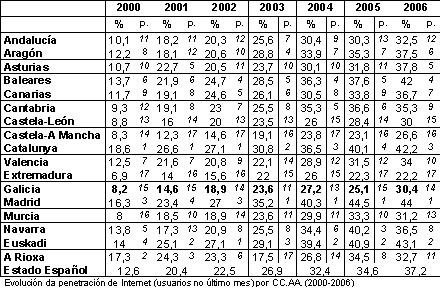
Los últimos datos sobre consumo y penetración de Internet, publicados esta mañana por la AIMC, dejan noticias contrapuestas sobre la “digitalización” del Estado Español. Por un lado aumenta ligeramente el número de personas que emplearon la red en algún momento en el último mes (37,2% frente al 36,8% de marzo) y en el último año esa cifra acumula un crecimiento del 2,6%. Sin embargo, en el último trimestre ha descendido el número de usuarios habituales de la red (los que lo había utilizado en el día anterior), pasando esta cifra del 21,7 al 21,4 por ciento. En el último año este parámetro se encuentra estancado (en mayo del 2005 la cifra era del 20%). Parece que el proceso de convergencia de España con la media de la Unión Europea aún va a hacerse esperar.
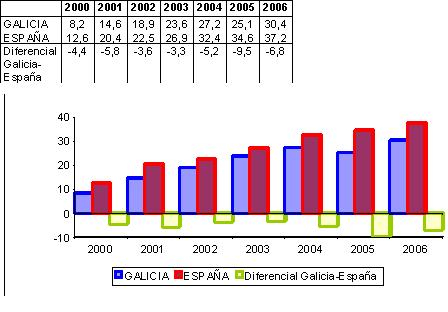
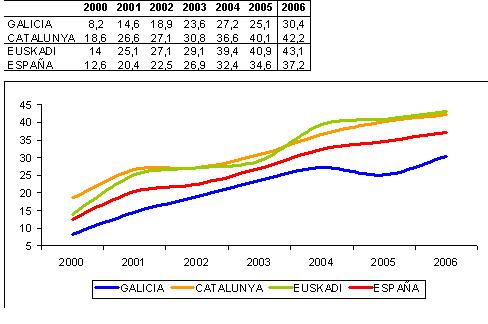
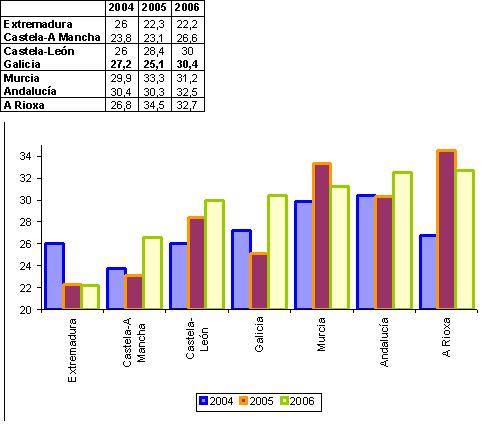
En cuanto a Galicia, los datos son más esperanzadores. Después de que en el año 2005, el nivel de penetración de Internet (usuarios en el último mes) descendiese al 25% de la población, en los últimos meses esta cifra ha repuntado hasta superar el treinta por ciento (30,4%), reduciendo el diferencial con la media española de 9,5 puntos a 6,8. Galicia supera a Castilla-León, y se acerca a los datos de Murcia, Andalucía y La Rioja. Con todo, es evidente que nadia debe darse por satisfecho con esta situación, puesto que Galicia es la 14ª Comunidad Autónoma (de 17) en acceso a Internet.


En cuanto a Galicia, los datos son más esperanzadores. Después de que en el año 2005, el nivel de penetración de Internet (usuarios en el último mes) descendiese al 25% de la población, en los últimos meses esta cifra ha repuntado hasta superar el treinta por ciento (30,4%), reduciendo el diferencial con la media española de 9,5 puntos a 6,8. Galicia supera a Castilla-León, y se acerca a los datos de Murcia, Andalucía y La Rioja. Con todo, es evidente que nadia debe darse por satisfecho con esta situación, puesto que Galicia es la 14ª Comunidad Autónoma (de 17) en acceso a Internet.
10.7.06
Global Media and Communication 1 August 2006; Vol. 2, No. 2
Editorial Global Media and Communication 2006;2 139-141 http://gmc.sagepub.com/cgi/reprint/2/2/139?etoc
Digging the global mine: an interview with Saskia Sassen Terhi Rantanen Global Media and Communication 2006;2 142-159 http://gmc.sagepub.com/cgi/reprint/2/2/142?etoc
A quest for dialogue in international broadcasting: Germany's public diplomacy targeting Arab audiences Oliver Zollner Global Media and Communication 2006;2 160-182 http://gmc.sagepub.com/cgi/content/abstract/2/2/160?etoc
US public diplomacy in the Arab world: the news credibility of Radio Sawa and Television Alhurra in five countries Mohammed el-Nawawy Global Media and Communication 2006;2 183-203 http://gmc.sagepub.com/cgi/content/abstract/2/2/183?etoc
The Mahatma didn't like the movies and why it matters: Indian broadcasting policy, 1920s-1990s Robin Jeffrey Global Media and Communication 2006;2 204-224 http://gmc.sagepub.com/cgi/content/abstract/2/2/204?etoc
The predictable responses to the Danish cartoons Peter Hervik Global Media and Communication 2006;2 225-230 http://gmc.sagepub.com/cgi/reprint/2/2/225?etoc
Book Review: The Record of the Paper:How The New York Times Misreports US Foreign Policy Daniel C. Hallin Global Media and Communication 2006;2 231-233 http://gmc.sagepub.com/cgi/reprint/2/2/231?etoc
Book Review: Big Brother International: Formats, Critics and Publics Jeanette Steemers Global Media and Communication 2006;2 233-236 http://gmc.sagepub.com/cgi/reprint/2/2/233?etoc
Book Review: Peace Journalism Angela Phillips Global Media and Communication 2006;2 236-239 http://gmc.sagepub.com/cgi/reprint/2/2/236?etoc
Book Review: The Success of Open Source Felix Stalder Global Media and Communication 2006;2 239-242 http://gmc.sagepub.com/cgi/reprint/2/2/239?etoc
TV Review: French television confronts urban revolts Tristan Mattelart Global Media and Communication 2006;2 243-250 http://gmc.sagepub.com/cgi/reprint/2/2/243?etoc
Web Review: It's not all Africa @ allafrica.com Lilian N. Ndangam Global Media and Communication 2006;2 251-256 http://gmc.sagepub.com/cgi/reprint/2/2/251?etoc
Policy Review: Assessing the effectiveness of UNESCO's new Convention on cultural diversity Garry Neil Global Media and Communication 2006;2 257-262 http://gmc.sagepub.com/cgi/reprint/2/2/257?etoc
Data: An IT profile of the Arab world Global Media and Communication 2006;2 263 http://gmc.sagepub.com/cgi/reprint/2/2/263?etoc
Digging the global mine: an interview with Saskia Sassen Terhi Rantanen Global Media and Communication 2006;2 142-159 http://gmc.sagepub.com/cgi/reprint/2/2/142?etoc
A quest for dialogue in international broadcasting: Germany's public diplomacy targeting Arab audiences Oliver Zollner Global Media and Communication 2006;2 160-182 http://gmc.sagepub.com/cgi/content/abstract/2/2/160?etoc
US public diplomacy in the Arab world: the news credibility of Radio Sawa and Television Alhurra in five countries Mohammed el-Nawawy Global Media and Communication 2006;2 183-203 http://gmc.sagepub.com/cgi/content/abstract/2/2/183?etoc
The Mahatma didn't like the movies and why it matters: Indian broadcasting policy, 1920s-1990s Robin Jeffrey Global Media and Communication 2006;2 204-224 http://gmc.sagepub.com/cgi/content/abstract/2/2/204?etoc
The predictable responses to the Danish cartoons Peter Hervik Global Media and Communication 2006;2 225-230 http://gmc.sagepub.com/cgi/reprint/2/2/225?etoc
Book Review: The Record of the Paper:How The New York Times Misreports US Foreign Policy Daniel C. Hallin Global Media and Communication 2006;2 231-233 http://gmc.sagepub.com/cgi/reprint/2/2/231?etoc
Book Review: Big Brother International: Formats, Critics and Publics Jeanette Steemers Global Media and Communication 2006;2 233-236 http://gmc.sagepub.com/cgi/reprint/2/2/233?etoc
Book Review: Peace Journalism Angela Phillips Global Media and Communication 2006;2 236-239 http://gmc.sagepub.com/cgi/reprint/2/2/236?etoc
Book Review: The Success of Open Source Felix Stalder Global Media and Communication 2006;2 239-242 http://gmc.sagepub.com/cgi/reprint/2/2/239?etoc
TV Review: French television confronts urban revolts Tristan Mattelart Global Media and Communication 2006;2 243-250 http://gmc.sagepub.com/cgi/reprint/2/2/243?etoc
Web Review: It's not all Africa @ allafrica.com Lilian N. Ndangam Global Media and Communication 2006;2 251-256 http://gmc.sagepub.com/cgi/reprint/2/2/251?etoc
Policy Review: Assessing the effectiveness of UNESCO's new Convention on cultural diversity Garry Neil Global Media and Communication 2006;2 257-262 http://gmc.sagepub.com/cgi/reprint/2/2/257?etoc
Data: An IT profile of the Arab world Global Media and Communication 2006;2 263 http://gmc.sagepub.com/cgi/reprint/2/2/263?etoc
Journalism 1 August 2006; Vol. 7, No. 3
Introduction Felix F. Gutierrez Journalism 2006;7 259-261 http://jou.sagepub.com/cgi/reprint/7/3/259?etoc
Ethnic media, community media and participatory culture Mark Deuze Journalism 2006;7 262-280 http://jou.sagepub.com/cgi/content/abstract/7/3/262?etoc
Competing discourses of community: Ideological tensions between local general-market and Latino news media Isabel Molina Guzman Journalism 2006;7 281-298 http://jou.sagepub.com/cgi/content/abstract/7/3/281?etoc
Reaching at risk groups: The importance of health storytelling in Los Angeles Latino media Holley A. Wilkin and Sandra J. Ball-Rokeach Journalism 2006;7 299-320 http://jou.sagepub.com/cgi/content/abstract/7/3/299?etoc
The role of Native American print and online media in the 'era of big stories': A comparative case study of Native American outlets' coverageof the Red Lake shootings George L. Daniels Journalism 2006;7 321-342 http://jou.sagepub.com/cgi/content/abstract/7/3/321?etoc
Ethnic print media in the multicultural nation of Canada: A case study of the black newspaper in Montreal Tokunbo Ojo Journalism 2006;7 343-361 http://jou.sagepub.com/cgi/content/abstract/7/3/343?etoc
Geo-ethnic storytelling: An examination of ethnic media content in contemporary immigrant communities Wan-Ying Lin and Hayeon Song Journalism 2006;7 362-388 http://jou.sagepub.com/cgi/content/abstract/7/3/362?etoc
Is changing the language enough? The Spanish-language 'alternative'in the USA Kristin C. Moran Journalism 2006;7 389-405 http://jou.sagepub.com/cgi/content/abstract/7/3/389?etoc
Book Review: Ethnic Media in America: Taking Control (Vol. 2), Ethnic Mediain America: Images, Audiences and Transforming Forces (Vol. 3) Jose Luis Benavides Journalism 2006;7 406-408 http://jou.sagepub.com/cgi/reprint/7/3/406?etoc
23.6.06
SdP 92: Máis sobre "Futebol e Comunicação"
A informação desportiva emitida na TVdirige-se aos sentidos ou ao pensamento?
Felisbela Lopes
É, sobretudo, através do olhar e do ouvido que acedemos àquilo que a televisão transmite, mas é igualmente no imaginário de cada um que os sentidos e os significados da imagem e do discurso televisivos acontecem. Isto significa que não pode haver nestes dois actos uma contraposição, mas uma continuidade. Concebendo o corpo como o meio que nos situa no mundo, uma espécie de axis mundi, a fenomenologia já havia neutralizado oposições como corpo/alma, físico/psíquico, sensível/inteligível. Concordando com estas teses, a proposta de encarar a pele como o limiar entre o que está fora e o que está dentro, mas também como o lugar que permite o contacto a partir do qual a comunicação se torna possível, reúne, na nossa perspectiva, traços pertinentes para pensar a informação desportiva veiculada pela TV. [Texto]
Felisbela Lopes
É, sobretudo, através do olhar e do ouvido que acedemos àquilo que a televisão transmite, mas é igualmente no imaginário de cada um que os sentidos e os significados da imagem e do discurso televisivos acontecem. Isto significa que não pode haver nestes dois actos uma contraposição, mas uma continuidade. Concebendo o corpo como o meio que nos situa no mundo, uma espécie de axis mundi, a fenomenologia já havia neutralizado oposições como corpo/alma, físico/psíquico, sensível/inteligível. Concordando com estas teses, a proposta de encarar a pele como o limiar entre o que está fora e o que está dentro, mas também como o lugar que permite o contacto a partir do qual a comunicação se torna possível, reúne, na nossa perspectiva, traços pertinentes para pensar a informação desportiva veiculada pela TV. [Texto]
The Harvard International Journal of Press/Politics 1 July 2006; Vol. 11, No. 3
Miller's Malfeasance and Woodward's Folly: The Crisis in Access Journalism Todd Gitlin The Harvard International Journal of Press/Politics 2006;11 3-6 http://hij.sagepub.com/cgi/reprint/11/3/3?etoc
The Role of Georgia's Media--and Western Aid--in the Rose Revolution David Anable The Harvard International Journal of Press/Politics 2006;11 7-43 http://hij.sagepub.com/cgi/reprint/11/3/7?etoc
Framing the Press and Publicity Process in U.S., British, and German General Election Campaigns: A Comparative Study of Metacoverage Frank Esser and Paul D'Angelo The Harvard International Journal of Press/Politics 2006;11 44-66 http://hij.sagepub.com/cgi/content/abstract/11/3/44?etoc
Policy Agenda Setting and Risk Communication: Greenpeace, Shell, and Issuesof Trust Vian Bakir The Harvard International Journal of Press/Politics 2006;11 67-88 http://hij.sagepub.com/cgi/content/abstract/11/3/67?etoc
Stealthy Wealth: The Untold Story of Welfare Privatization Michelle Brophy-Baermann and Andrew J. Bloeser The Harvard International Journal of Press/Politics 2006;11 89-112 http://hij.sagepub.com/cgi/content/abstract/11/3/89?etoc
Dispelling Late-Night Myths: News Consumption among Late-Night Comedy Viewers and the Predictors of Exposure to Various Late-Night Shows Dannagal G. Young and Russell M. Tisinger The Harvard International Journal of Press/Politics 2006;11 113-134 http://hij.sagepub.com/cgi/content/abstract/11/3/113?etoc
Knowledge about the Gulf Wars: A Theoretical Model of Learning from the News Ven-hwei Lo and Chingching Chang The Harvard International Journal of Press/Politics 2006;11 135-155 http://hij.sagepub.com/cgi/content/abstract/11/3/135?etoc
Book Notes Scott L. Althaus The Harvard International Journal of Press/Politics 2006;11 156-157 http://hij.sagepub.com/cgi/reprint/11/3/156?etoc
14.6.06
BRITISH JOURNALISM REVIEW, 1 June 2006; Vol. 17, No. 2
Listen to the Lord British Journalism Review 2006;17 3-5 http://bjr.sagepub.com/cgi/content/abstract/17/2/3?etoc
Quotes of the Quarter British Journalism Review 2006;17 6 http://bjr.sagepub.com/cgi/reprint/17/2/6?etoc
Kinnock: where Clarke was right Bill Hagerty British Journalism Review 2006;17 7-14 http://bjr.sagepub.com/cgi/content/abstract/17/2/7?etoc
Stand up and be counted Will Wyatt British Journalism Review 2006;17 15-20 http://bjr.sagepub.com/cgi/content/abstract/17/2/15?etoc
Grumpy Humpy should bow out Michael White British Journalism Review 2006;17 21-26 http://bjr.sagepub.com/cgi/content/abstract/17/2/21?etoc
Sabotaging of a star Tim Luckhurst British Journalism Review 2006;17 27-31 http://bjr.sagepub.com/cgi/content/abstract/17/2/27?etoc
The way we were British Journalism Review 2006;17 32 http://bjr.sagepub.com/cgi/reprint/17/2/32?etoc
Unequal war of the web Francis Jezierski British Journalism Review 2006;17 33-38 http://bjr.sagepub.com/cgi/content/abstract/17/2/33?etoc
Fast stalker Jane Bown British Journalism Review 2006;17 39-43 http://bjr.sagepub.com/cgi/content/abstract/17/2/39?etoc
Mind your language Roger Bolton British Journalism Review 2006;17 44-49 http://bjr.sagepub.com/cgi/content/abstract/17/2/44?etoc
Gone and (largely) forgotten British Journalism Review 2006;17 50-52 http://bjr.sagepub.com/cgi/reprint/17/2/50?etoc
Beware the press in times of war Stephen Bax British Journalism Review 2006;17 53-58 http://bjr.sagepub.com/cgi/content/abstract/17/2/53?etoc
Why Papers of record are history John Campbell British Journalism Review 2006;17 59-64 http://bjr.sagepub.com/cgi/content/abstract/17/2/59?etoc
Clean sweep in the Ukraine Stewart Purvis British Journalism Review 2006;17 65-69 http://bjr.sagepub.com/cgi/content/abstract/17/2/65?etoc
Encyclopedic knowledge Anthony Delano British Journalism Review 2006;17 70-71 http://bjr.sagepub.com/cgi/reprint/17/2/70?etoc
Perished jungle Martyn Gregory British Journalism Review 2006;17 72-73 http://bjr.sagepub.com/cgi/reprint/17/2/72?etoc
A rebel roused Michael Leapman British Journalism Review 2006;17 74-75 http://bjr.sagepub.com/cgi/reprint/17/2/74?etoc
Pants on fire Liz Vercoe British Journalism Review 2006;17 76-77 http://bjr.sagepub.com/cgi/reprint/17/2/76?etoc
War draw Martin Rowson British Journalism Review 2006;17 78-80 http://bjr.sagepub.com/cgi/reprint/17/2/78?etoc
5.6.06
FÚTBOL Y COMUNICACIÓN
El Portal de la Comunicación InCom-UAB, en colaboración con el Centre d'Estudis Olímpics UAB, ha preparado este Monográfico del Portal con una selección de enlaces en los que se analiza el Barça, y el fútbol en general, como fenómeno cultural y de comunicación.
Chris Kennett"Barça: ¿Contenido para los medios, mediador o símbolo?"Poco antes de las 23h. del 17 de mayo, el FC Barcelona fue proclamado ganador de la European Champions League de la UEFA ante más de 80.000 personas y de una audiencia global estimada en más de 150 millones. [...]
> Documentos en líneaALABARCES, Pablo: "Futbologías Fútbol, identidad y violencia en América Latina". CLACSO, Grupo de Trabajo Deporte y Sociedad, 2003.
BAK, Les: "Beyond the racist/hooligan couplet: race, social theory and football culture". British Journal of Sociology, Volume 50, Number 3. September 1, 1999.
BAR-ON, T.: "The Ambiguities of Football, Politics, Culture, and Social Transformation in Latin America". Sociological Research Online, vol. 2, no. 4. 1997.
CARNIBELLA, Giovanni: "Football violence in Europe". The Social Issues Research Centre, july 1996.
CUDWELL, Jayne: "Women's Experiences of Sexuality Within Football Contexts: A Particular and Located Footballing Epistemology". Football Studies, 2002.
GIULIANOTTI, Richard: "Avenues of contestation. Football hooligans running and ruling urban spaces". Social Anthropology, 2002.
GREEN, Richard: "Football information services: fanzines, 'Match of the Day' and the MODEM". Aslib Proceedings, 1999.
JACOPIN, Tanguy; MURILLO, Carles: "El caso del nou barça". Observatorio de Relaciones con Latino América (Universitat Pompeu Fabra), 2005.
MURILLO, Carles: "Modelo Messi o de la agilidad en el mercado". Observatorio de Relaciones con Latino América (Universitat Pompeu Fabra), 2006.
NASH, Rex: "Contestation in Modern English Professional Football: The Independent Supporters Association Movement". International Review for the Sociology of Sport, Vol. 35, No. 4. 2000.
ORIARD, Michael: "Professional Football as Cultural Myth". Journal of American Culture, Volume 4. Fall 1981.
RODERICK, Martin: "Playing Hurt: Managing Injuries in English Professional Football". International Review for the Sociology of Sport, Vol. 35, No. 2. 2000.
SALVADOR, Jordi Josep: "Futbol, metàfora d'una guerra freda, un estudi antropològic del Barça". Departament d'Antropologia, Filosofia i Treball Social, Universitat Rovira i Virgili, 2004.
TACON, Richard: "Football and Social Inclusion: Evaluating Social Policy". Football Governance Resarch Centre of Birkbeck (University of London), 2005.
VÁZQUEZ MONTALBÁN, Manuel: "Arqueologia i subcultura" a ARTELLS, Joan Josep: Barça, Barça, Barça. Barcelona: Editorial Laia, 1972.
> Artículos en prensa
CASTELLS, Manuel: "Fútbol, globalización, identidad". La Vanguardia, 6 de mayo de 2006. En Universidade de Santiago de Compostela.
DOLINA, Alejandro: "¿Puede el fútbol producir algún placer estético?". Pasión Redonda, febrero de 2006.
MARTÍNEZ, Marta: "Miedo al fútbol. Museos y teatros cambian su programa para no coincidir con la final de la Champions". El País, 15 de mayo de 2006.
MORAGAS, Miquel: "Cultura y comunicación". La Vanguardia, 8 de agosto de 2004.
SERRAT, Joan Manuel: "Aquest any, sí". El País, 17 de mayo de 2006.
Chris Kennett"Barça: ¿Contenido para los medios, mediador o símbolo?"Poco antes de las 23h. del 17 de mayo, el FC Barcelona fue proclamado ganador de la European Champions League de la UEFA ante más de 80.000 personas y de una audiencia global estimada en más de 150 millones. [...]
> Documentos en líneaALABARCES, Pablo: "Futbologías Fútbol, identidad y violencia en América Latina". CLACSO, Grupo de Trabajo Deporte y Sociedad, 2003.
BAK, Les: "Beyond the racist/hooligan couplet: race, social theory and football culture". British Journal of Sociology, Volume 50, Number 3. September 1, 1999.
BAR-ON, T.: "The Ambiguities of Football, Politics, Culture, and Social Transformation in Latin America". Sociological Research Online, vol. 2, no. 4. 1997.
CARNIBELLA, Giovanni: "Football violence in Europe". The Social Issues Research Centre, july 1996.
CUDWELL, Jayne: "Women's Experiences of Sexuality Within Football Contexts: A Particular and Located Footballing Epistemology". Football Studies, 2002.
GIULIANOTTI, Richard: "Avenues of contestation. Football hooligans running and ruling urban spaces". Social Anthropology, 2002.
GREEN, Richard: "Football information services: fanzines, 'Match of the Day' and the MODEM". Aslib Proceedings, 1999.
JACOPIN, Tanguy; MURILLO, Carles: "El caso del nou barça". Observatorio de Relaciones con Latino América (Universitat Pompeu Fabra), 2005.
MURILLO, Carles: "Modelo Messi o de la agilidad en el mercado". Observatorio de Relaciones con Latino América (Universitat Pompeu Fabra), 2006.
NASH, Rex: "Contestation in Modern English Professional Football: The Independent Supporters Association Movement". International Review for the Sociology of Sport, Vol. 35, No. 4. 2000.
ORIARD, Michael: "Professional Football as Cultural Myth". Journal of American Culture, Volume 4. Fall 1981.
RODERICK, Martin: "Playing Hurt: Managing Injuries in English Professional Football". International Review for the Sociology of Sport, Vol. 35, No. 2. 2000.
SALVADOR, Jordi Josep: "Futbol, metàfora d'una guerra freda, un estudi antropològic del Barça". Departament d'Antropologia, Filosofia i Treball Social, Universitat Rovira i Virgili, 2004.
TACON, Richard: "Football and Social Inclusion: Evaluating Social Policy". Football Governance Resarch Centre of Birkbeck (University of London), 2005.
VÁZQUEZ MONTALBÁN, Manuel: "Arqueologia i subcultura" a ARTELLS, Joan Josep: Barça, Barça, Barça. Barcelona: Editorial Laia, 1972.
> Artículos en prensa
CASTELLS, Manuel: "Fútbol, globalización, identidad". La Vanguardia, 6 de mayo de 2006. En Universidade de Santiago de Compostela.
DOLINA, Alejandro: "¿Puede el fútbol producir algún placer estético?". Pasión Redonda, febrero de 2006.
MARTÍNEZ, Marta: "Miedo al fútbol. Museos y teatros cambian su programa para no coincidir con la final de la Champions". El País, 15 de mayo de 2006.
MORAGAS, Miquel: "Cultura y comunicación". La Vanguardia, 8 de agosto de 2004.
SERRAT, Joan Manuel: "Aquest any, sí". El País, 17 de mayo de 2006.
COLUMBIA JOURNALISM REVIEW, MAY-JUNE 2006
Out of Time A journalist set out to teach basic reporting to a group of inmates, and got a new appreciation for what it means to miss a deadline. By Bruce Porter.
The Cameramen We remember the images they provide, but seldom consider the gutsy pros whom TV news couldn't do without. By Jim Wooten.
Mind Games In the amorphous 'war on terror,' the government's strategy to frame reality often distorts it, and puts the credibility of the military and the press at risk. By Daniel Schulman.
Back Story A book tour was not what the doctor ordered, but for this writer, pain, pills, and debilitating side effects were worth the trip. By Jacques Leslie.
Listen to This In little more than a decade Pitchfork has gone from a labor of love to the Web's foremost musical tastemaker. By Kiera Butler.
Editorial Whether it's AIDS or Iraq, context is key.
Voices Mike Hoyt pays to place his mother's obit, but he's not happy about it. Former police reporter Bob Kochersberger reconsiders reporting 101 after reading about his son's crime.
Darts & Laurels Softballs for Cheney, an affair to forget, extreme makeover at CBS, and more. By Gloria Cooper.
State of the Art Redefining environmental coverage at Grist magazine. By Kevin Friedl.
First Person For a former New York City police reporter, a grim landmark lurks around many a corner. By Wendell Jamieson.
Scene In China, first the interrogation, then lunch. By Ralph Jennings.
Essay Robert S. Boynton on Gay Talese's curious new memoir.
The Cameramen We remember the images they provide, but seldom consider the gutsy pros whom TV news couldn't do without. By Jim Wooten.
Mind Games In the amorphous 'war on terror,' the government's strategy to frame reality often distorts it, and puts the credibility of the military and the press at risk. By Daniel Schulman.
Back Story A book tour was not what the doctor ordered, but for this writer, pain, pills, and debilitating side effects were worth the trip. By Jacques Leslie.
Listen to This In little more than a decade Pitchfork has gone from a labor of love to the Web's foremost musical tastemaker. By Kiera Butler.
Editorial Whether it's AIDS or Iraq, context is key.
Voices Mike Hoyt pays to place his mother's obit, but he's not happy about it. Former police reporter Bob Kochersberger reconsiders reporting 101 after reading about his son's crime.
Darts & Laurels Softballs for Cheney, an affair to forget, extreme makeover at CBS, and more. By Gloria Cooper.
State of the Art Redefining environmental coverage at Grist magazine. By Kevin Friedl.
First Person For a former New York City police reporter, a grim landmark lurks around many a corner. By Wendell Jamieson.
Scene In China, first the interrogation, then lunch. By Ralph Jennings.
Essay Robert S. Boynton on Gay Talese's curious new memoir.
NORDICOM REVIEW, 2006/1
Martin Engebretsen
Shallow and Static or Deep and Dynamic? Studying the State of Online Journalism in Scandinavia (pdf)
Peeter Vihalemm
Media Use in Estonia. Trends and Patterns (pdf)
Göran Eriksson
Rethinking the Rethinking. The Problem of Generality in Qualitative Media Audience Research (pdf)
Birgitte Mral
The Rhetorical State of Alert before the Iraq War 2003 (pdf)
Berit von der Lippe
Images of Victory – Images of Masculinity? (pdf)
Tine Ustad Figenschou
Courting, Criticism, Censorship and Bombs. The Bush Administration’s Troubled Relations with al-Jazeera Channel from September 11 to the War in Iraq (pdf)
Lars Nyre
Apologetic Media Research (pdf)
Birgitta Höijer
Are We as Attentive to Method as We Should Be? (pdf)
Current Research Projects
Espen Ytreberg, Trine Syvertsen
Participation and Play in Converging Media. Institutional Perspectives and Text-user Relations
(pdf)
Barbara Gentikow
New Media as ”Cultural Techniques” and as Forums for Communicative Action Empirical Research and Constituents of a Theory (pdf)
Anna Sparrman
Young People’s Consumption of Visual Culture. Collector Gadgets, Sexuality and Democracy (pdf)
Tom Moring
European Public Sphere(s). Uniting and Dividing (pdf)
Richard Raskin
Cinematic Representations of the Israeli-Palestinian Conflict. A Statement of Intentions (pdf)
New Litterature (pdf)
Shallow and Static or Deep and Dynamic? Studying the State of Online Journalism in Scandinavia (pdf)
Peeter Vihalemm
Media Use in Estonia. Trends and Patterns (pdf)
Göran Eriksson
Rethinking the Rethinking. The Problem of Generality in Qualitative Media Audience Research (pdf)
Birgitte Mral
The Rhetorical State of Alert before the Iraq War 2003 (pdf)
Berit von der Lippe
Images of Victory – Images of Masculinity? (pdf)
Tine Ustad Figenschou
Courting, Criticism, Censorship and Bombs. The Bush Administration’s Troubled Relations with al-Jazeera Channel from September 11 to the War in Iraq (pdf)
Lars Nyre
Apologetic Media Research (pdf)
Birgitta Höijer
Are We as Attentive to Method as We Should Be? (pdf)
Current Research Projects
Espen Ytreberg, Trine Syvertsen
Participation and Play in Converging Media. Institutional Perspectives and Text-user Relations
(pdf)
Barbara Gentikow
New Media as ”Cultural Techniques” and as Forums for Communicative Action Empirical Research and Constituents of a Theory (pdf)
Anna Sparrman
Young People’s Consumption of Visual Culture. Collector Gadgets, Sexuality and Democracy (pdf)
Tom Moring
European Public Sphere(s). Uniting and Dividing (pdf)
Richard Raskin
Cinematic Representations of the Israeli-Palestinian Conflict. A Statement of Intentions (pdf)
New Litterature (pdf)
Studies in Communication Sciences, vol.5 n.2, dec 2005
Peter Schulz, Kent Nakamoto Enhancing health literacy through communication
Lynne Eagle, Jim Reid, Jacinta Hawkins , Erica Styles Breaking through the Invisible Barrier of Low Functional Health Literacy: Implications for Health Communication
Kristina Eriksson-Backa Active Acquisition or Passive Reception: Health Information Literacy among Fifty Finns in Differing Health Situations
Sara Rubinelli ‘Ask Your Doctor’. Argumentation in Advertising of Prescription Medicines
John C. Tedesco, Rachel Holloway Deceptive Health Promotion: Barriers to Health Literacy
Sandra A. Smith , Virginia Gonzales Developing Culturally and Linguistically Appropriate Health Education Materials
Ashli Quensinberry Stokes Healthology, Health Literacy, and the Pharmaceutically Empowered Consumer
M. Krishna Erramilli, Piyush Sharma, Cindy Chung, Bharadhwaj Sivakumaran Health Literacy, Sex Education and Contraception: The Singapore Experience
Joanne G. Schwartzberg, Missy Fleming, Katherine C. Vergara, Carrie Oliver , Jonathan B. VanGeest Evaluating a Health Literacy Kit for Physicians
Desiree C. Duff, Kim Witte , Arvind Singhal Health Literacy and Mass-Mediated Interventions. Effects of Taru, a Reproductive Health Soap Opera in India
Duncan Howe, Brenda Bevan Remmes, David Kellin , James Timmons, Jr. Improving the Health Literacy of Rural Health Care Consumers
Charis Psaltis Communication and the Construction of Knowledge or Transmission of Belief. The Role of Conversation Type, Behavioral Style and Social Recognition
Maag Daniela Health Literacy – Compendium of Prior Research
Van Leuven Nancy Health Literacy in the Hills. How a California Community Reshaped its Well-being
Wunsch Marta J. Health Literacy-more than Reading a Prescription Label
Sanjinés Josè Afterthought on Silence:Towards a Poetics of Self-Communication
Cacchione Annamaria Why Reported Speech Matters for the Communication Theory: Some Side Notes on Emilia Calaresu
Lynne Eagle, Jim Reid, Jacinta Hawkins , Erica Styles Breaking through the Invisible Barrier of Low Functional Health Literacy: Implications for Health Communication
Kristina Eriksson-Backa Active Acquisition or Passive Reception: Health Information Literacy among Fifty Finns in Differing Health Situations
Sara Rubinelli ‘Ask Your Doctor’. Argumentation in Advertising of Prescription Medicines
John C. Tedesco, Rachel Holloway Deceptive Health Promotion: Barriers to Health Literacy
Sandra A. Smith , Virginia Gonzales Developing Culturally and Linguistically Appropriate Health Education Materials
Ashli Quensinberry Stokes Healthology, Health Literacy, and the Pharmaceutically Empowered Consumer
M. Krishna Erramilli, Piyush Sharma, Cindy Chung, Bharadhwaj Sivakumaran Health Literacy, Sex Education and Contraception: The Singapore Experience
Joanne G. Schwartzberg, Missy Fleming, Katherine C. Vergara, Carrie Oliver , Jonathan B. VanGeest Evaluating a Health Literacy Kit for Physicians
Desiree C. Duff, Kim Witte , Arvind Singhal Health Literacy and Mass-Mediated Interventions. Effects of Taru, a Reproductive Health Soap Opera in India
Duncan Howe, Brenda Bevan Remmes, David Kellin , James Timmons, Jr. Improving the Health Literacy of Rural Health Care Consumers
Charis Psaltis Communication and the Construction of Knowledge or Transmission of Belief. The Role of Conversation Type, Behavioral Style and Social Recognition
Maag Daniela Health Literacy – Compendium of Prior Research
Van Leuven Nancy Health Literacy in the Hills. How a California Community Reshaped its Well-being
Wunsch Marta J. Health Literacy-more than Reading a Prescription Label
Sanjinés Josè Afterthought on Silence:Towards a Poetics of Self-Communication
Cacchione Annamaria Why Reported Speech Matters for the Communication Theory: Some Side Notes on Emilia Calaresu
JOURNALISM, May 1 2006, Volume 7, No. 2
Reporting through the lens of the past
from Challenger to Columbia Jill A. Edy
Miglena Daradanova
University of Oklahoma
Collective memory, the publicly shared meaning of a common past, can structure both news stories and reporters' search for information within the broader context of journalistic practices. It can also provide reporters with an independent perspective, balancing elite-dominated news frames. Following the space shuttle Columbia's crash, journalists turned repeatedly to the ‘lessons' of the accident that claimed the Challenger shuttle 17 years earlier both in formulating questions at NASA briefings and in reporting Columbia's destruction and the subsequent investigation in print. In many instances, journalists' reliance on these memories is entirely implicit in the finished news stories, making Challenger a ghostly presence that led reporters to focus on NASA's inadequacies rather than on the mechanical causes of Columbia's demise.
Key Words: Challenger crash • Columbia crash • collective memory • framing • hegemony • press autonomy • space reporting • typification
[Reprint (PDF) Version of Edy and Daradanova]
What is good journalism? comparing Israeli public and journalists' perspectives Yariv Tsfati
Oren Meyers
University of Haifa, Israel
Yoram Peri
Tel Aviv University, Israel
The frequent referencing of service to the public interest as a core professional journalistic value raises the question of the correspondence between the perception of journalists and the public as to what constitutes good and bad journalism. In this study, a sample of Israeli journalists and a sample of the Israeli public were asked a series of questions about the core values and practices of journalism. Results suggest four major conclusions: first, Israeli journalists have a clear, relatively uniform perception of what constitutes worthy journalism. Second, journalists and the public differ in the degrees of significance they assign to various journalistic norms and practices. Third, the public is slightly more positive in its overall assessment of the Israeli media in comparison with the journalists. Finally, the two general assessments are constituted by different, or even opposing, components.
Key Words: Israel • journalistic values • public opinion
[Reprint (PDF) Version of Tsfati et al.]
Gendered mobility, the nation and the woman's page
exploring the mobile practices of the Canadian lady journalist, 1888–1895
Sandra Gabriele
Carleton University, Canada
This article explores the domestic travel writing of two women journalists who wrote for competing partisan papers in Toronto – Kit Coleman of The Daily Mail and Faith Fenton of The Empire. Using what I refer to as ‘mobile practices', Coleman and Fenton found a middle ground between the conventional regimes of domestic femininity represented in many of the features of their woman's pages, and the emerging conditions of modern travel that allowed women to explore new places. Woman's pages and travel writing allowed the newspaper to contribute to nation-building in a multitude of ways and across a number of sites, such as the family, the city and countryside, Canada's colonial history and women's roles as the moral heads of household. In turn, mobile practices were both strategies for dealing with the emerging conditions of modernity as much as they were instruments for its continuation.
Key Words: Coleman, Kathleen Blake (Kit) • domestic femininity • Freeman, Alice (Faith Fenton) • journalism history • modernity • newspapers • travel writing • women journalists
[Reprint (PDF) Version of Gabriele]
Newspapers' transition from women's to style pages
what were they thinking?
Dustin Harp
University of Texas at Austin, USA
After nearly a century of publishing explicitly named women's pages, US newspapers starting in 1969 and into the 1970s began renaming them ‘style’ or ‘lifestyle’ sections, theoretically meaning they were for a general audience. This research investigates industry discourse during this time to determine what those in newsrooms were thinking about this transition. Seventy-two articles from three newspaper trade publications from 1969 through 1975 reveal that editors and reporters were most concerned with including serious content in these sections and unconcerned with the names of the sections. In fact the women editors of these style pages, who dominated the discourse, indicated that even after renaming the sections industry insiders thought of them as for and about women. The analysis also revealed that newsroom constraints, particularly those placed on lower level staff by male editors, prevented women editors of these women's/style sections from constructing the pages they desired.
Key Words: feminism • news • US newspapers • women • women's sections • women's pages
[Reprint (PDF) Version of Harp]
Translation, adaptation, globalization
the Vietnam News
Theo van Leeuwen
University of Technology, Sydney, Australia
The Vietnam News is an English language daily newspaper produced on behalf of the Vietnamese Government, as part of its market reform policies. Drawing on an analysis of 100 translations from the Vietnamese press and their rewrites by the paper's foreign sub-editors, as well as on interviews with sub-editors and journalist-translators working at the Vietnam News, the article documents the translation and adaptation decisions that constitute the process of globalizing the discourse of the Vietnamese press in this particular instance. Three kinds of decisions are discussed in turn: translation decisions affecting the English used, translation/adaptation decisions affecting journalistic style, and translation/adaptation decisions affecting cultural and ideological references in the source texts. The article ends by asking whether the Vietnamese press is best served by closely following the Anglo-Australian model, as it does at present, or by developing its own distinct local style.
Key Words: attribution • censorship • journalistic style • leads • localization • nominalization • sub-editing • Vietnamese press
[Reprint (PDF) Version of van Leeuwen]
Public journalism
a reply to critics
Tanni Haas
Brooklyn College, USA
Linda Steiner
Rutgers University, USA
This article analyzes and responds to the most significant criticisms of public journalism made by scholars. After discussing public journalism advocates’ alleged failure to define public journalism clearly, we examine more specific criticisms. Among other issues, few advocates have taken seriously the likely impact of commercial imperatives on public journalism's modes of operation. We argue, however, that public journalism projects show that reform-oriented news organizations can challenge long-standing journalistic conventions, despite managements’ interests in maximizing profit. Ultimately, we argue, public journalism's long-term viability depends on continuing, explicit commitment by journalists, its institutionalization within newsrooms and journalism classrooms, and continued theory-development, research, and assessment.
Key Words: citizen participation • civic journalism • journalism theory • public sphere
[Reprint (PDF) Version of Haas and Steiner]
from Challenger to Columbia Jill A. Edy
Miglena Daradanova
University of Oklahoma
Collective memory, the publicly shared meaning of a common past, can structure both news stories and reporters' search for information within the broader context of journalistic practices. It can also provide reporters with an independent perspective, balancing elite-dominated news frames. Following the space shuttle Columbia's crash, journalists turned repeatedly to the ‘lessons' of the accident that claimed the Challenger shuttle 17 years earlier both in formulating questions at NASA briefings and in reporting Columbia's destruction and the subsequent investigation in print. In many instances, journalists' reliance on these memories is entirely implicit in the finished news stories, making Challenger a ghostly presence that led reporters to focus on NASA's inadequacies rather than on the mechanical causes of Columbia's demise.
Key Words: Challenger crash • Columbia crash • collective memory • framing • hegemony • press autonomy • space reporting • typification
[Reprint (PDF) Version of Edy and Daradanova]
What is good journalism? comparing Israeli public and journalists' perspectives Yariv Tsfati
Oren Meyers
University of Haifa, Israel
Yoram Peri
Tel Aviv University, Israel
The frequent referencing of service to the public interest as a core professional journalistic value raises the question of the correspondence between the perception of journalists and the public as to what constitutes good and bad journalism. In this study, a sample of Israeli journalists and a sample of the Israeli public were asked a series of questions about the core values and practices of journalism. Results suggest four major conclusions: first, Israeli journalists have a clear, relatively uniform perception of what constitutes worthy journalism. Second, journalists and the public differ in the degrees of significance they assign to various journalistic norms and practices. Third, the public is slightly more positive in its overall assessment of the Israeli media in comparison with the journalists. Finally, the two general assessments are constituted by different, or even opposing, components.
Key Words: Israel • journalistic values • public opinion
[Reprint (PDF) Version of Tsfati et al.]
Gendered mobility, the nation and the woman's page
exploring the mobile practices of the Canadian lady journalist, 1888–1895
Sandra Gabriele
Carleton University, Canada
This article explores the domestic travel writing of two women journalists who wrote for competing partisan papers in Toronto – Kit Coleman of The Daily Mail and Faith Fenton of The Empire. Using what I refer to as ‘mobile practices', Coleman and Fenton found a middle ground between the conventional regimes of domestic femininity represented in many of the features of their woman's pages, and the emerging conditions of modern travel that allowed women to explore new places. Woman's pages and travel writing allowed the newspaper to contribute to nation-building in a multitude of ways and across a number of sites, such as the family, the city and countryside, Canada's colonial history and women's roles as the moral heads of household. In turn, mobile practices were both strategies for dealing with the emerging conditions of modernity as much as they were instruments for its continuation.
Key Words: Coleman, Kathleen Blake (Kit) • domestic femininity • Freeman, Alice (Faith Fenton) • journalism history • modernity • newspapers • travel writing • women journalists
[Reprint (PDF) Version of Gabriele]
Newspapers' transition from women's to style pages
what were they thinking?
Dustin Harp
University of Texas at Austin, USA
After nearly a century of publishing explicitly named women's pages, US newspapers starting in 1969 and into the 1970s began renaming them ‘style’ or ‘lifestyle’ sections, theoretically meaning they were for a general audience. This research investigates industry discourse during this time to determine what those in newsrooms were thinking about this transition. Seventy-two articles from three newspaper trade publications from 1969 through 1975 reveal that editors and reporters were most concerned with including serious content in these sections and unconcerned with the names of the sections. In fact the women editors of these style pages, who dominated the discourse, indicated that even after renaming the sections industry insiders thought of them as for and about women. The analysis also revealed that newsroom constraints, particularly those placed on lower level staff by male editors, prevented women editors of these women's/style sections from constructing the pages they desired.
Key Words: feminism • news • US newspapers • women • women's sections • women's pages
[Reprint (PDF) Version of Harp]
Translation, adaptation, globalization
the Vietnam News
Theo van Leeuwen
University of Technology, Sydney, Australia
The Vietnam News is an English language daily newspaper produced on behalf of the Vietnamese Government, as part of its market reform policies. Drawing on an analysis of 100 translations from the Vietnamese press and their rewrites by the paper's foreign sub-editors, as well as on interviews with sub-editors and journalist-translators working at the Vietnam News, the article documents the translation and adaptation decisions that constitute the process of globalizing the discourse of the Vietnamese press in this particular instance. Three kinds of decisions are discussed in turn: translation decisions affecting the English used, translation/adaptation decisions affecting journalistic style, and translation/adaptation decisions affecting cultural and ideological references in the source texts. The article ends by asking whether the Vietnamese press is best served by closely following the Anglo-Australian model, as it does at present, or by developing its own distinct local style.
Key Words: attribution • censorship • journalistic style • leads • localization • nominalization • sub-editing • Vietnamese press
[Reprint (PDF) Version of van Leeuwen]
Public journalism
a reply to critics
Tanni Haas
Brooklyn College, USA
Linda Steiner
Rutgers University, USA
This article analyzes and responds to the most significant criticisms of public journalism made by scholars. After discussing public journalism advocates’ alleged failure to define public journalism clearly, we examine more specific criticisms. Among other issues, few advocates have taken seriously the likely impact of commercial imperatives on public journalism's modes of operation. We argue, however, that public journalism projects show that reform-oriented news organizations can challenge long-standing journalistic conventions, despite managements’ interests in maximizing profit. Ultimately, we argue, public journalism's long-term viability depends on continuing, explicit commitment by journalists, its institutionalization within newsrooms and journalism classrooms, and continued theory-development, research, and assessment.
Key Words: citizen participation • civic journalism • journalism theory • public sphere
[Reprint (PDF) Version of Haas and Steiner]
31.5.06
Public Opinion Quarterly. Summer 2006; Vol. 70, No. 2
--------------------------------Articles-----------------------
Military Triumph, Racial Transcendence, and Colin Powell Donald R. Kinder and Corrine M. McConnaughy Public Opin Q 2006 70: 139-165. http://poq.oxfordjournals.org/cgi/content/abstract/70/2/139?etoc
Same-Gender Sex in the United States: Impact of T-Acasi on Prevalence Estimates Maria A. Villarroel, Charles F. Turner, Elizabeth Eggleston, Alia Al-Tayyib, Susan M. Rogers, Anthony M. Roman, Philip C. Cooley, and Harper Gordek Public Opin Q 2006 70: 166-196. http://poq.oxfordjournals.org/cgi/content/abstract/70/2/166?etoc
Can Registration-Based Sampling Improve the Accuracy of Midterm Election Forecasts? Donald P. Green and Alan S. Gerber Public Opin Q 2006 70: 197-223. http://poq.oxfordjournals.org/cgi/content/abstract/70/2/197?etoc
----------------Research Notes-------------------------------------------------------------
Do Absentee Voters Differ from Polling Place Voters?: New Evidence from California Matt A. Barreto, Matthew J. Streb, Mara Marks, and Fernando Guerra Public Opin Q 2006 70: 224-234. http://poq.oxfordjournals.org/cgi/content/abstract/70/2/224?etoc
Character Counts?: Honesty and Fairness in Election 2000 Benjamin G. Bishin, Daniel Stevens, and Christian Wilson Public Opin Q 2006 70: 235-248. http://poq.oxfordjournals.org/cgi/content/abstract/70/2/235?etoc
---------------------The Polls----------------------------------------------------------------- Obesity Costas Panagopoulos Public Opin Q 2006 70: 249-268. http://poq.oxfordjournals.org/cgi/content/full/70/2/249?etoc
------------------Book Reviews----------------------------------------------------------------William C. Adams. Election Night News and Voter Turnout: Solving the Projection Puzzle. Boulder, CO: Lynne Rienner Publishers. 2005. 149 pp. $49.95 (cloth). Trevor Tompson Public Opin Q 2006 70: 269-271. http://poq.oxfordjournals.org/cgi/content/full/70/2/269?etoc
Daniel Lipinski. Congressional Communication: Content and Consequences. Ann Arbor: University of Michigan Press. 2004. 160 pp. $29.95 (paper). Stephanie Burkhalter Public Opin Q 2006 70: 271-275. http://poq.oxfordjournals.org/cgi/content/full/70/2/271?etoc
18.5.06
THE FUTURE OF PAPERS (The Philadelphia Inquirer)
Can The Inquirer and Philadelphia Daily News build a future on the back of their Web site, Philly.com?
That is a critical question for the investors pondering bids for the two newspapers and Web site.
Will there come a day when readers, advertisers and revenue fleeing the newspapers will be captured by the Web site - in numbers sufficient to sustain the expensive business of covering news, sports, arts and culture in the nation's sixth-largest metropolitan area?
"I think it's safe to say that the consensus in the industry right now is that nobody has figured it out. That's the holy grail," said Ken Doctor, lead analyst with Outsell, a media research company, and a former vice president for the digital arm of Knight Ridder Inc., parent of The Inquirer and the Daily News.
The Wall Street Journal has attracted 771,000 paying customers to its Web site, but virtually every other newspaper publisher has concluded that charging for online access is not worth the revenue it would generate. And revenue from online ads, while growing rapidly, remains a fraction of overall newspaper revenue.
It was in that environment that Knight Ridder agreed in March to be purchased by the McClatchy Co., which plans to sell 12 of Knight Ridder's 32 papers, including the two in Philadelphia.
A partnership of the MediaNews Group Inc., of Denver, and others have agreed to buy four of those papers. The rest are still in play, pursued by MediaNews and other bidders.
Worries about shrinking profit and a cloudy future for newspapers, especially those in large urban markets, precipitated the sale. Some industry analysts wonder whether the worries are justified, especially if the audience and revenue growth of newspapers' online sites are factored in.
About 61 percent of Americans still look primarily to their local daily newspaper for local news, according to Outsell, which polled 2,800 consumers. Only 6 percent turn to such sites as Google, Yahoo and MSN.
John Morton, an independent media analyst, pointed out that ad revenue on many newspaper Web sites had grown 30 percent to 40 percent despite competition from the likes of Craigslist and Monster.com.
"A lot of people don't realize that in almost every market, the second-largest audience is the local newspaper's Web site, and the largest is the newspaper," Morton said.
Just last week, the Audit Bureau of Circulations reported that daily newspaper circulation nationwide fell 1.2 million, to 45.4 million, in the year that ended March 31. Meanwhile, the bureau said, online readership of newspapers grew more than five million, to 56 million.
Philly.com's revenue is growing but remains a small portion of the business. Last year, Philly.com accounted for about $20 million, or 5 percent of total ad revenue for the combined publications. This year, online ad revenue is up more than 30 percent.
Philly.com looks for new ways to attract users, including interactive features, said its general manager, Dennis Wichterman Jr.
"We're constantly growing on this front," he said. The site offers blogs, discussion boards and polls, he said. "We're currently looking at the possibility of photo community publishing as well."
The Daily News in the next several weeks plans to add a crime blog and an online afternoon edition with news on traffic, entertainment and other information, said Frank Burgos, the newspaper's editorial page editor and new media editor.
But he said Philly.com and many other newspaper sites needed to improve in several ways by:
Becoming 24-hour news operations, posting news on Web sites immediately.
Adding blogs and other ways for readers to debate and interact.
Figuring out how to deal with the increasing use of keyword searches, which take people using a search engine to a newspaper Web site only if it ranks high in their search.
Spending money to promote the newspaper and the Web site as the best source for local news, shopping and other information.
"One of the weaknesses we have at the building is not having much of a promotional budget," Burgos said.
Even though many newspaper Web sites have added shopping and other interactive features, competitors have already nabbed many of those opportunities.
"The 'Craigslist Revolution' is also dramatically affecting the purchase of classified ads," according to the Outsell report. Forty-eight percent of the Internet users it surveyed had used Craigslist, eBay, or other online auctions to buy or sell something in the previous 12 months, compared with 10 percent who bought print classified ads to sell.
And while Internet ad sales remain small, they are growing quickly.
Newspaper ad revenue is growing at just 3 percent yearly, according to media-and-communications investment firm Veronis Suhler Stevenson. Internet advertising, however, is expected to grow 25 percent this year.
Trends like that have hit newspaper profits hard.
In the first quarter this year, profit fell 53 percent at Knight Ridder; 20 percent at the New York Times, excluding a onetime gain of $68 million last year on the sale of its headquarters; 11.5 percent at Gannett (owner of USA Today); and 14 percent at McClatchy.
Ken Marlin, managing partner of Marlin & Associates, an investment-banking and consulting firm that focuses on technology and the Internet, said too many newspaper managers were still focused on simply transferring the traditional newspaper to the Web. Instead, he said, they should use the value of their brands to give readers new services.
One possibility: Readers could read a restaurant review, then click on a link that lets them make a reservation. Similar models could be developed for movies, cars and other items, allowing newspapers to charge businesses for the service, he said.
"Most newspapers understand cities very, very well," Marlin said. "They ought to be the best vehicle for people to get access to the city. Most newspapers just don't get it."
Philly.com and other sites do let readers buy movie tickets and other products, but the industry as a whole, critics say, has failed to make consumers think of them first in the same way that coffee drinkers think Starbucks.
Some news organizations, Marlin said, are starting to get it. They are adding audio, more photos and video to their Web sites, as well as information available only on the Web. They also are expanding their brands to non-news sites.
Marlin cited the acquisition of MySpace, a social networking site popular with young people, by Rupert Murdoch's News Corp. Similarly, the New York Times Co. acquired About.com, a collection of Web sites on a wide variety of topics, and the Wall Street Journal acquired MarketWatch, a business news site.
Leonard M. Apcar, editor of NYTimes.com, said newspapers would survive both in print and on the Web.
"I think print is a very durable, very viable product, but I think the Web is extremely strong and that readers read the two very differently," he said.
NYTimes.com, for example, had to turn away ads because its pages were full. That sounds like good news, but it also points out a challenge: getting more people to look at more pages on an individual site, which would create more ad space. Internet ads are sold based on the number of page views.
About half the people who visit NYTimes.com are sent to an article from another site and never see the home page, Apcar said. NYTimes.com has redesigned its site to encourage surfing."The goal of the redesign," he said, "was to get people into the article page and hold them longer."
http://www.philly.com/mld/philly/business/14572642.htm
That is a critical question for the investors pondering bids for the two newspapers and Web site.
Will there come a day when readers, advertisers and revenue fleeing the newspapers will be captured by the Web site - in numbers sufficient to sustain the expensive business of covering news, sports, arts and culture in the nation's sixth-largest metropolitan area?
"I think it's safe to say that the consensus in the industry right now is that nobody has figured it out. That's the holy grail," said Ken Doctor, lead analyst with Outsell, a media research company, and a former vice president for the digital arm of Knight Ridder Inc., parent of The Inquirer and the Daily News.
The Wall Street Journal has attracted 771,000 paying customers to its Web site, but virtually every other newspaper publisher has concluded that charging for online access is not worth the revenue it would generate. And revenue from online ads, while growing rapidly, remains a fraction of overall newspaper revenue.
It was in that environment that Knight Ridder agreed in March to be purchased by the McClatchy Co., which plans to sell 12 of Knight Ridder's 32 papers, including the two in Philadelphia.
A partnership of the MediaNews Group Inc., of Denver, and others have agreed to buy four of those papers. The rest are still in play, pursued by MediaNews and other bidders.
Worries about shrinking profit and a cloudy future for newspapers, especially those in large urban markets, precipitated the sale. Some industry analysts wonder whether the worries are justified, especially if the audience and revenue growth of newspapers' online sites are factored in.
About 61 percent of Americans still look primarily to their local daily newspaper for local news, according to Outsell, which polled 2,800 consumers. Only 6 percent turn to such sites as Google, Yahoo and MSN.
John Morton, an independent media analyst, pointed out that ad revenue on many newspaper Web sites had grown 30 percent to 40 percent despite competition from the likes of Craigslist and Monster.com.
"A lot of people don't realize that in almost every market, the second-largest audience is the local newspaper's Web site, and the largest is the newspaper," Morton said.
Just last week, the Audit Bureau of Circulations reported that daily newspaper circulation nationwide fell 1.2 million, to 45.4 million, in the year that ended March 31. Meanwhile, the bureau said, online readership of newspapers grew more than five million, to 56 million.
Philly.com's revenue is growing but remains a small portion of the business. Last year, Philly.com accounted for about $20 million, or 5 percent of total ad revenue for the combined publications. This year, online ad revenue is up more than 30 percent.
Philly.com looks for new ways to attract users, including interactive features, said its general manager, Dennis Wichterman Jr.
"We're constantly growing on this front," he said. The site offers blogs, discussion boards and polls, he said. "We're currently looking at the possibility of photo community publishing as well."
The Daily News in the next several weeks plans to add a crime blog and an online afternoon edition with news on traffic, entertainment and other information, said Frank Burgos, the newspaper's editorial page editor and new media editor.
But he said Philly.com and many other newspaper sites needed to improve in several ways by:
Becoming 24-hour news operations, posting news on Web sites immediately.
Adding blogs and other ways for readers to debate and interact.
Figuring out how to deal with the increasing use of keyword searches, which take people using a search engine to a newspaper Web site only if it ranks high in their search.
Spending money to promote the newspaper and the Web site as the best source for local news, shopping and other information.
"One of the weaknesses we have at the building is not having much of a promotional budget," Burgos said.
Even though many newspaper Web sites have added shopping and other interactive features, competitors have already nabbed many of those opportunities.
"The 'Craigslist Revolution' is also dramatically affecting the purchase of classified ads," according to the Outsell report. Forty-eight percent of the Internet users it surveyed had used Craigslist, eBay, or other online auctions to buy or sell something in the previous 12 months, compared with 10 percent who bought print classified ads to sell.
And while Internet ad sales remain small, they are growing quickly.
Newspaper ad revenue is growing at just 3 percent yearly, according to media-and-communications investment firm Veronis Suhler Stevenson. Internet advertising, however, is expected to grow 25 percent this year.
Trends like that have hit newspaper profits hard.
In the first quarter this year, profit fell 53 percent at Knight Ridder; 20 percent at the New York Times, excluding a onetime gain of $68 million last year on the sale of its headquarters; 11.5 percent at Gannett (owner of USA Today); and 14 percent at McClatchy.
Ken Marlin, managing partner of Marlin & Associates, an investment-banking and consulting firm that focuses on technology and the Internet, said too many newspaper managers were still focused on simply transferring the traditional newspaper to the Web. Instead, he said, they should use the value of their brands to give readers new services.
One possibility: Readers could read a restaurant review, then click on a link that lets them make a reservation. Similar models could be developed for movies, cars and other items, allowing newspapers to charge businesses for the service, he said.
"Most newspapers understand cities very, very well," Marlin said. "They ought to be the best vehicle for people to get access to the city. Most newspapers just don't get it."
Philly.com and other sites do let readers buy movie tickets and other products, but the industry as a whole, critics say, has failed to make consumers think of them first in the same way that coffee drinkers think Starbucks.
Some news organizations, Marlin said, are starting to get it. They are adding audio, more photos and video to their Web sites, as well as information available only on the Web. They also are expanding their brands to non-news sites.
Marlin cited the acquisition of MySpace, a social networking site popular with young people, by Rupert Murdoch's News Corp. Similarly, the New York Times Co. acquired About.com, a collection of Web sites on a wide variety of topics, and the Wall Street Journal acquired MarketWatch, a business news site.
Leonard M. Apcar, editor of NYTimes.com, said newspapers would survive both in print and on the Web.
"I think print is a very durable, very viable product, but I think the Web is extremely strong and that readers read the two very differently," he said.
NYTimes.com, for example, had to turn away ads because its pages were full. That sounds like good news, but it also points out a challenge: getting more people to look at more pages on an individual site, which would create more ad space. Internet ads are sold based on the number of page views.
About half the people who visit NYTimes.com are sent to an article from another site and never see the home page, Apcar said. NYTimes.com has redesigned its site to encourage surfing."The goal of the redesign," he said, "was to get people into the article page and hold them longer."
http://www.philly.com/mld/philly/business/14572642.htm
GLOBAL MEDIA JOURNAL en español (primavera 2006)
Reportes de investigación arbitrados
1. El tratamiento informativo de la inmigración en la prensa y la televisión española. Una aproximación empírica desde la Teoría del Framing. Juan José Igartua, Carlos Muñiz y José A. Otero, Universidad de Salamanca - España
2. Tendencias de cambio en las empresas informativas. Francisco J. Caro González y Gloria Jiménez Marín, Universidad de Sevilla - España
Artículos arbitrados
3. Recepção televisiva: pesquisas brasileiras da década de 1990. Nilda Jacks - Brasil
4. Políticas públicas en la industria televisiva mexicana: Un análisis desde la perspectiva de género . Juan Enrique Huerta, ITESM Campus Monterrey - México
5. Elementos para una teoría del lenguaje de los textos periodísticos impresos. Una modalidad discursiva. Yamile Haber Guerra, Periódico Sierra Maestra - Cuba
6. Estudios y aplicaciones integradas de comunicación para el desarrollo organizacional. Katia Muñoz, Universidad de Viña del Mar - Chile
7. Publicidad, violencia e infancia: consideraciones en torno a una pragmática funcional del discurso publicitario en televisión. Juan Miguel Aguado e Inmaculada J. Martínez, Universidad de Murcia - España
8. Políticas de comunicación, un tema pendiente en la agenda. María de la Luz Casas, ITESM Campus Cuernavaca - México
9. Muchos oyen, pero pocos escuchan: El papel de los medios en la formación de la opinión pública y la realidad. Marcos Sebastián Pérez Peña, Universidad de Santiago de Compostela - España
10. Desesperadamente buscando a la audiencia cinematográfica brasileña, o Cómo y por qué los estudios brasileños de cine siguen siendo textualistas. Fernando Mascarello, Universidade do Vale do Rio dos Sinos (Unisinos) – Brasil
1. El tratamiento informativo de la inmigración en la prensa y la televisión española. Una aproximación empírica desde la Teoría del Framing. Juan José Igartua, Carlos Muñiz y José A. Otero, Universidad de Salamanca - España
2. Tendencias de cambio en las empresas informativas. Francisco J. Caro González y Gloria Jiménez Marín, Universidad de Sevilla - España
Artículos arbitrados
3. Recepção televisiva: pesquisas brasileiras da década de 1990. Nilda Jacks - Brasil
4. Políticas públicas en la industria televisiva mexicana: Un análisis desde la perspectiva de género . Juan Enrique Huerta, ITESM Campus Monterrey - México
5. Elementos para una teoría del lenguaje de los textos periodísticos impresos. Una modalidad discursiva. Yamile Haber Guerra, Periódico Sierra Maestra - Cuba
6. Estudios y aplicaciones integradas de comunicación para el desarrollo organizacional. Katia Muñoz, Universidad de Viña del Mar - Chile
7. Publicidad, violencia e infancia: consideraciones en torno a una pragmática funcional del discurso publicitario en televisión. Juan Miguel Aguado e Inmaculada J. Martínez, Universidad de Murcia - España
8. Políticas de comunicación, un tema pendiente en la agenda. María de la Luz Casas, ITESM Campus Cuernavaca - México
9. Muchos oyen, pero pocos escuchan: El papel de los medios en la formación de la opinión pública y la realidad. Marcos Sebastián Pérez Peña, Universidad de Santiago de Compostela - España
10. Desesperadamente buscando a la audiencia cinematográfica brasileña, o Cómo y por qué los estudios brasileños de cine siguen siendo textualistas. Fernando Mascarello, Universidade do Vale do Rio dos Sinos (Unisinos) – Brasil
SALA DE PRENSA, 91, maio 2006
El quinto poder. La sociedad frente a los medios de comunicación de masas en la era de la globalización
Ignacio Ramonet
La globalización es también la globalización de los medios de comunicación y de información, y estos megagrupos (que los poseen) ya no se plantean como objetivo cívico el de ser un “cuarto poder” para corregir los disfuncionamientos de la democracia y perfeccionar así este sistema político. Ni desean ser un “cuarto poder”, ni tampoco se proponen de actuar como un contra-poder. Podríamos decir que si estos grupos constituyen un eventual “cuarto poder”, sería en el sentido de que ese cuarto poder se une, se añade, se suma a los otros poderes existentes –Legislativo, Ejecutivo y Judicial–, al poder político y al poder económico, para aplastar a su vez, como poder suplementario, al ciudadano.
Por consiguiente, la cuestión cívica que se plantea es: ¿Cómo resistir, reaccionar, cómo oponerse, frente a lo que fue durante mucho tiempo el único poder de los ciudadanos en oposición a los poderes dominantes? ¿Cómo resistir frente a la ofensiva de este nuevo poder que en cierta medida traicionó al ciudadano pasándose al adversario? Pienso que lo que se debería hacer es crear sencillamente un “quinto poder”. Un quinto poder que nos permita oponer una fuerza cívica ciudadana a esa nueva suma, a esa nueva alianza de poderes. [Texto]
ESPECIAL: DÍA MUNDIAL DE LA LIBERTAD DE PRENSA
“Todas las noticias que no pueden publicarse”Carlos Lauría
CPJ: Los diez países donde existe más censura
RSF: Los secuestradores de la libertad de expresión
UNESCO: fin a la impunidad de agresores de la prensaKoïchiro Matsuura
Mecanismos Internacionales para la Promoción de la Libertad de ExpresiónONU, OSCE, OEA
Ignacio Ramonet
La globalización es también la globalización de los medios de comunicación y de información, y estos megagrupos (que los poseen) ya no se plantean como objetivo cívico el de ser un “cuarto poder” para corregir los disfuncionamientos de la democracia y perfeccionar así este sistema político. Ni desean ser un “cuarto poder”, ni tampoco se proponen de actuar como un contra-poder. Podríamos decir que si estos grupos constituyen un eventual “cuarto poder”, sería en el sentido de que ese cuarto poder se une, se añade, se suma a los otros poderes existentes –Legislativo, Ejecutivo y Judicial–, al poder político y al poder económico, para aplastar a su vez, como poder suplementario, al ciudadano.
Por consiguiente, la cuestión cívica que se plantea es: ¿Cómo resistir, reaccionar, cómo oponerse, frente a lo que fue durante mucho tiempo el único poder de los ciudadanos en oposición a los poderes dominantes? ¿Cómo resistir frente a la ofensiva de este nuevo poder que en cierta medida traicionó al ciudadano pasándose al adversario? Pienso que lo que se debería hacer es crear sencillamente un “quinto poder”. Un quinto poder que nos permita oponer una fuerza cívica ciudadana a esa nueva suma, a esa nueva alianza de poderes. [Texto]
ESPECIAL: DÍA MUNDIAL DE LA LIBERTAD DE PRENSA
“Todas las noticias que no pueden publicarse”Carlos Lauría
CPJ: Los diez países donde existe más censura
RSF: Los secuestradores de la libertad de expresión
UNESCO: fin a la impunidad de agresores de la prensaKoïchiro Matsuura
Mecanismos Internacionales para la Promoción de la Libertad de ExpresiónONU, OSCE, OEA
European Journal of Communication 1 June 2006; Vol. 21, No. 2
Do Politicians Lead the Tango?: A Study of the Relationship between SwedishJournalists and their Political Sources in the Context of Election Campaigns Jesper Stromback and Lars W. Nord European Journal of Communication 2006;21 147-164 http://ejc.sagepub.com/cgi/content/abstract/21/2/147?etoc
Is There a European Public Sphere?: The Berlusconi-Schulz Case John Downey and Thomas Koenig European Journal of Communication 2006;21 165-187 http://ejc.sagepub.com/cgi/content/abstract/21/2/165?etoc
Censorship in Contemporary Russian Journalism in the Age of the War AgainstTerrorism: A Historical Perspective Greg Simons and Dmitry Strovsky European Journal of Communication 2006;21 189-211 http://ejc.sagepub.com/cgi/content/abstract/21/2/189?etoc
Research Note: Individual Differences in Perceptions of Internet Communication Jochen Peter and Patti M. Valkenburg European Journal of Communication 2006;21 213-226 http://ejc.sagepub.com/cgi/content/abstract/21/2/213?etoc
Research Note: Sensationalism in Dutch Current Affairs Programmes 1992-2001 Paul Hendriks Vettehen, Koos Nuijten, and Johannes W.J. Beentjes European Journal of Communication 2006;21 227-237 http://ejc.sagepub.com/cgi/content/abstract/21/2/227?etoc
Review Article: Falling Apart, Together Derek Mckiernan European Journal of Communication 2006;21 239-244 http://ejc.sagepub.com/cgi/reprint/21/2/239?etoc
Book Review: Ethnic Minorities, Electronic Media, and the Public Sphere: A Comparative Approach Simon Cottle European Journal of Communication 2006;21 245-247 http://ejc.sagepub.com/cgi/reprint/21/2/245?etoc
Book Review: The Media and the Tourist Imagination: Converging Cultures Andre Jansson European Journal of Communication 2006;21 247-250 http://ejc.sagepub.com/cgi/reprint/21/2/247?etoc
Book Review: Citizens or Consumers: What the Media Tell Us about Political Participation Darren G. Lilleker European Journal of Communication 2006;21 250-252 http://ejc.sagepub.com/cgi/reprint/21/2/250?etoc
Book Review: Beacon of Hatred: Inside Hizballah's Al Manar Television Mohamed Zayani European Journal of Communication 2006;21 252-256 http://ejc.sagepub.com/cgi/reprint/21/2/252?etoc
Book Review: ITV Cultures: Independent Television Over Fifty Years Andrew Crisell European Journal of Communication 2006;21 256-257 http://ejc.sagepub.com/cgi/reprint/21/2/256?etoc
Book Review: The Politics of Marketing the Labour Party Colin Seymour-Ure European Journal of Communication 2006;21 258-260 http://ejc.sagepub.com/cgi/reprint/21/2/258?etoc
Book Review: The Record of the Paper: How the New York Times Misreports US Foreign Policy Mark Hampton European Journal of Communication 2006;21 260-262 http://ejc.sagepub.com/cgi/reprint/21/2/260?etoc
Book Review: Popular Television Drama: Critical Perspectives Helena Sheehan European Journal of Communication 2006;21 263-265 http://ejc.sagepub.com/cgi/reprint/21/2/263?etoc
Book Review: Media and the Make-Believe Worlds of Children: When Harry Potter Meets Pokemon in Disneyland Ruth Zanker European Journal of Communication 2006;21 265-269 http://ejc.sagepub.com/cgi/reprint/21/2/265?etoc
Is There a European Public Sphere?: The Berlusconi-Schulz Case John Downey and Thomas Koenig European Journal of Communication 2006;21 165-187 http://ejc.sagepub.com/cgi/content/abstract/21/2/165?etoc
Censorship in Contemporary Russian Journalism in the Age of the War AgainstTerrorism: A Historical Perspective Greg Simons and Dmitry Strovsky European Journal of Communication 2006;21 189-211 http://ejc.sagepub.com/cgi/content/abstract/21/2/189?etoc
Research Note: Individual Differences in Perceptions of Internet Communication Jochen Peter and Patti M. Valkenburg European Journal of Communication 2006;21 213-226 http://ejc.sagepub.com/cgi/content/abstract/21/2/213?etoc
Research Note: Sensationalism in Dutch Current Affairs Programmes 1992-2001 Paul Hendriks Vettehen, Koos Nuijten, and Johannes W.J. Beentjes European Journal of Communication 2006;21 227-237 http://ejc.sagepub.com/cgi/content/abstract/21/2/227?etoc
Review Article: Falling Apart, Together Derek Mckiernan European Journal of Communication 2006;21 239-244 http://ejc.sagepub.com/cgi/reprint/21/2/239?etoc
Book Review: Ethnic Minorities, Electronic Media, and the Public Sphere: A Comparative Approach Simon Cottle European Journal of Communication 2006;21 245-247 http://ejc.sagepub.com/cgi/reprint/21/2/245?etoc
Book Review: The Media and the Tourist Imagination: Converging Cultures Andre Jansson European Journal of Communication 2006;21 247-250 http://ejc.sagepub.com/cgi/reprint/21/2/247?etoc
Book Review: Citizens or Consumers: What the Media Tell Us about Political Participation Darren G. Lilleker European Journal of Communication 2006;21 250-252 http://ejc.sagepub.com/cgi/reprint/21/2/250?etoc
Book Review: Beacon of Hatred: Inside Hizballah's Al Manar Television Mohamed Zayani European Journal of Communication 2006;21 252-256 http://ejc.sagepub.com/cgi/reprint/21/2/252?etoc
Book Review: ITV Cultures: Independent Television Over Fifty Years Andrew Crisell European Journal of Communication 2006;21 256-257 http://ejc.sagepub.com/cgi/reprint/21/2/256?etoc
Book Review: The Politics of Marketing the Labour Party Colin Seymour-Ure European Journal of Communication 2006;21 258-260 http://ejc.sagepub.com/cgi/reprint/21/2/258?etoc
Book Review: The Record of the Paper: How the New York Times Misreports US Foreign Policy Mark Hampton European Journal of Communication 2006;21 260-262 http://ejc.sagepub.com/cgi/reprint/21/2/260?etoc
Book Review: Popular Television Drama: Critical Perspectives Helena Sheehan European Journal of Communication 2006;21 263-265 http://ejc.sagepub.com/cgi/reprint/21/2/263?etoc
Book Review: Media and the Make-Believe Worlds of Children: When Harry Potter Meets Pokemon in Disneyland Ruth Zanker European Journal of Communication 2006;21 265-269 http://ejc.sagepub.com/cgi/reprint/21/2/265?etoc
Subscribe to:
Posts (Atom)
